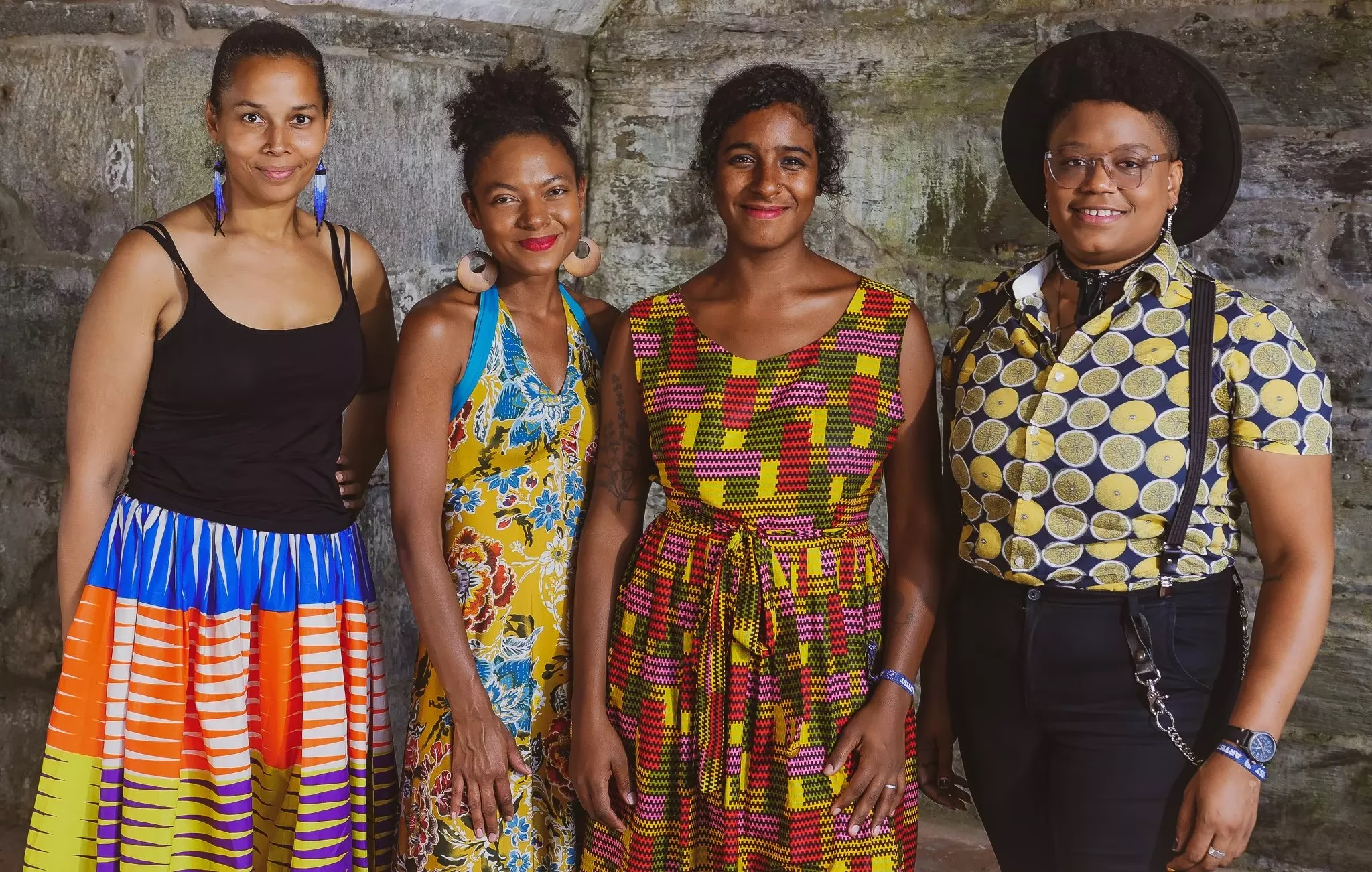
Newport Folk has always hosted historic musical and cutural moments, but when the roots music supergroup of Rhiannon Giddens, Leyla McCalla, Allison Russell, Amythyst Kiah know as Our Native Daughters close out their debut run of shows, history took center stage.
Best described by Smithsonian Folkways, the album Songs Of Our Native Daughters "shines new light on African-American women’s stories of struggle, resistance, and hope. Pulling from and inspired by 17th-, 18th-, and 19th-century sources, including slave narratives and early minstrelsy, [Giddens, McCalla, Russell and Kiah] reinterpret and create new works from old ones."
<iframe width="620" height="349" src="https://www.youtube.com/embed/jG1sRvFDnU0" frameborder="0" allow="accelerometer; autoplay; encrypted-media; gyroscope; picture-in-picture" allowfullscreen></iframe>
"Black women have been makers and markers of social change in the United States for centuries, at this point," McCalla said. "I think this album is a part of that," adding, "We're looking back at the past, but the music is for today."
Just after their landmark first-ever set on the Newport Folk Quad Stage, the Recording Academy sat down with the quartet to hear how the project came together, what tools they used to create it, how they hope it will affect the narrative of history and more.
Why was Newport Folk the right place for Our Native Daughters perform in this brief initial tour?
Giddens: Well it just seemed like the right thing, because Newport folk festival has such a history to it and I know that they've been really trying especially recently to really build on that legacy. In a way, even more than they have in the past. You know, just really make it about the folk music and about what folk music can do. And so when the offer came in, it just made so much sense. If we could build a tour around it and let this be the sort of finale to this part of the tour, it's really amazing.
Obviously, this is a and very historical and research-heavy concept for an album, but the music rings out fresh and very alive. How did you approach the daunting task of balancing the historical elements with the musical elements?
Russell: Well I think we really approached it song by song. I would say Rhiannon was struck with the idea to do something like this when she was given a private tour of the National Museum of African American History and Culture with her daughter. And that's a painful experience for anyone, let alone a descendant of some of the people who were enslaved. And a quote, a William Cowper quote really sparked the idea, and it was a quote to the effect of, "slavery is terrible, but how could we do without our sugar and our rum?" And the correlation to our modern day dependence on technologies that are being supplied by slave labor… that connection really resonated in her mind and she invited all of us to come and join her and sort of explore some of that history.
Initially the project, the idea was to kind of explore some early slave songs and minstrel music and we did a little bit of that with, with her adaptation of 'Better Get Your Learnin'." But we really realized we had a lot, we're all songwriters and we had a lot of feelings to process around all of this painful history, which is so much in evidence that these ghosts have not been laid to rest. Clearly the divisiveness in our country, the kind of outright racist and fascist rhetoric that's coming from the highest offices in our land is indicative of the fact that this history is not sleeping easy. It is affecting our present on all of us directly and all of you, directly. And so we, we felt like we had some things to say.
Giddens: I think it's also just the recognition of the lack of reckoning around the effects of slavery in the United States and the Atlantic Slave Trade. And even though we come from this place of a lot of research and reading and engaging with like academic material, I think that we've been living in our skin our whole life and that's a part of our experience. We've inherited some of this trauma in different ways and we represent different parts of the African diaspora. And so it made sense for us to come together and try to process this together. And honestly we didn't really know what exactly that was going to land us. And, like Alli said, I really think it was song by song. It was like; 'I have this musical idea, I have this musical idea, I have this phrase that has been turning in my mind,' 'Well, oh, I just came up with something that plays off of that.' And it was very collaborative.
<blockquote class="twitter-tweet"><p lang="en" dir="ltr">2019 ARTIST ANNOUNCEMENT: Please welcome Our Native Daughters (<a href="https://twitter.com/RhiannonGiddens?ref_src=twsrc%5Etfw">@RhiannonGiddens</a> <a href="https://twitter.com/jtandalli?ref_src=twsrc%5Etfw">@jtandalli</a> <a href="https://twitter.com/LeylaMcCalla?ref_src=twsrc%5Etfw">@LeylaMcCalla</a> <a href="https://twitter.com/amythystkiah?ref_src=twsrc%5Etfw">@amythystkiah</a>) to this year's Sunday lineup. <a href="https://twitter.com/newportfestsorg?ref_src=twsrc%5Etfw">@newportfestsorg</a> has made a donation on their behalf to <a href="https://twitter.com/kidz_notes?ref_src=twsrc%5Etfw">@kidz_notes</a>. Learn more: <a href="https://t.co/9IjxshNW2W">https://t.co/9IjxshNW2W</a> <a href="https://t.co/5JCaqe6Qr8">pic.twitter.com/5JCaqe6Qr8</a></p>— Newport Folk Fest (@Newportfolkfest) <a href="https://twitter.com/Newportfolkfest/status/1115992874900951045?ref_src=twsrc%5Etfw">April 10, 2019</a></blockquote> <script async src="https://platform.twitter.com/widgets.js" charset="utf-8"></script>
Can you tell us more about the instrumentation and the instruments you used?
Kiah: The banjo was the centerpiece, all of the songs in some capacity needed to revolve around the banjo because the banjo is a descendant of the West African loot family. And historically, at least in contemporary music times, it has been very long associated with white male, three finger style bluegrass players. And that history has been sort of muddled and lost because of the segregation of the commercial music industry. There were black banjo players, black fiddlers and once the record executives wanted to market music, they assumed that, 'well only white people are going to listen to string band music,' so black people had to put down their banjos and fiddles and pick up a guitar and play the blues or play jazz if they wanted to make a living making music.
So this was obviously spun from Rhiannon's Inspiration, but her idea to take the banjo and to reclaim it as something that is also part of black culture because all of us in some capacity have lived like on the in-between of you know, not being black enough or not being white enough because of our interests and, even though by default, if someone is moved by music or move by something, they should be able to like it. There shouldn't have to be a birthright to be able to enjoy your love something, but just in case here is the historical backstory this instrument. And so that was really important to have that because that more or less blasts away the myth of like, 'what is blackness?' You know, what it means to be black, it goes to show that we're not a monolith and there's all sorts of ways to express yourself regardless of what your race is. So the banjo was really important. And then we had fiddle, we had drums and really just song by song, we kind of pieced together what instruments would make sense to serve the song. I think that's kind of kind of how we pieced arrangements together.
Giddens: Yeah, we were in Louisiana, we worked with Dirk Powell, who's a got a lovely, very small studio and it's kind of a built out of a very old, one room house that was once owned by a Creole family nearby. And it's just got all this history to it and he was great to work with, in that he was really very much setting up the sounds and then we just got in there and just did our thing… It was a very much a kind of fostering of like; 'I want what you want.' You know? 'I just wanna make it sound really good,' And so that it became a very safe space and it was a space where we all just felt very comfortable to, "oh and let me try this banjo or that or do that." And we weren't afraid to put electric guitar on and we weren't afraid to put modern instruments on it because it's not a historical record. It's something inspired by histories and inspired by these instruments and we wanted to use those sounds just because that's what we play.
Russell: We're all multi-instrumentalists, as well. We all do play banjo, different banjos, each of us. Rhiannon plays a fretless minstrel banjo, I play a five string, gut-string banjo, Leyla plays a tenor banjo, Amythyst plays a steal string. So we all have different banjos, but we also play other things. Amythyst is an incredible guitarist, Leyla is a classically trained phenomenal cellist. I tootle along on the clarinet and plink on the Ukulele [laughs humbly] and Rhiannon plays like eight to 25 instruments as far as I can tell-
Giddens: I play also fiddle [laughs humbly].
Russell: So we all, you know, we were kind of bringing all our little babies into the project as well.
McCalla: I think it's also that the banjo, like despite how much research we've done on the history of the Banjo, the Banjo is a modern instrument and it is relevant to the conversation of, 'what is folk music and what is American music?' I think the banjo is essential to that conversation. We're looking back at the past, but the music is for today.
<iframe width="620" height="349" src="https://www.youtube.com/embed/asIgRED_Yp0" frameborder="0" allow="accelerometer; autoplay; encrypted-media; gyroscope; picture-in-picture" allowfullscreen></iframe>
What types of conversations are you hoping listeners will have from experiencing this album?
Giddens: Well, I'd like to think that maybe people that are possibly on the fence with the whole... I think this will really be helpful for the people that are like, "Well, isn't racism over? We elected a black president. Isn't racism done?" I think this is a record for people that are asking that question and these subjects are difficult to talk about just face to face. You can talk about it academically with other academics but when you talk to a person that doesn't know the history... A lot of people don't necessarily understand it or people get too upset and don't want to talk about it. Like they kind of go into like a bit of an emotional crisis of either not wanting to hear about it or being defensive.
And so music has a way of disarming people. It's like sugar for the medicine, if you will. You know, these are these harsh realities of things that happened. Because these things happened, this is why things have evolved the way they have, socially, in our culture. This is a way to to disarm people and allow them to think and realize, "oh, this is why we still need to talk about this," you know? Because we're all sort of wrapped in this trauma of that part of our history that still affects how we interact with each other and the kind of legislative policies that we make and all those kinds of things that affects that, whether people see it or not. And hopefully with this record, people can maybe start thinking about it and having that conversation.
The album's liner notes serves as an emotional, historical and contextual companion to the album, and the song by song information is very insightful Can you talk about how they support the music?
Giddens: Well, the liners were collaboration. I wrote the essay.
Russell: It's a great essay.
Giddens: I got together the bibliography, I really wanted people- I mean the problem is that people forget that something always comes from something else. So knowledge is always coming from a place and I have such a respect and such a debt to the scholars who really found such amazing, you know, facts and figures and put them all together. And especially nowadays, these incredibly sensitive, like really, really just well done books. And so I wanted people to know where to go, you know and also to say this is where I got my information from, because I'm not making any of it up and I don't want credit for that.
And then I asked the ladies to give what they would want people to know most about each song, and Dirk wrote something. I just think it's important also to acknowledge him, all of the folks at the Smithsonian Folkways, most of which are white dudes. There is a relationship with allies going on here and I think that that's really important because, in this day and age, there's a lot of kind of, us versus them and I'm like, the only way forward really is to accept the platform that's given to you and the help that comes along with that and then you say your thing. It was like we weren't in any way needing anybody to help us say what we wanted to say, we just needed the space to do it.
So it's really important, I think, to acknowledge that, and to say, "This is how we can work together and not by you guys writing our story, but by you guys letting us have the space to write our story." And in this day and age, that's what it takes, and that's okay. You know what I mean? That's the way to turn it around. It's not like, "No, we don't need your help." It's like, "No, actually, because of the behemoth that we're shifting, it's going to take that." It's going to take the handout and then, "thank you. I got it now." You know what I mean? "Thanks for giving us the space." So I just think that's really important to say, and I'm glad that the Smithsonian has the budget to put liner notes in [laughs].
<iframe width="620" height="349" src="https://www.youtube.com/embed/F0_zoaPdUmI" frameborder="0" allow="accelerometer; autoplay; encrypted-media; gyroscope; picture-in-picture" allowfullscreen></iframe>
Russell: And I think, something that you said, this idea of allyship and moving forward and we move forward together. It's a family, it might be a dysfunctional, broken family, but it's a family. This country is still very young and its strength is also where the fault lines can, you know, when there's fear-mongering going on, those fault lines can crack and break and people can have the illusion of some sort of inseparable gulf between themselves and someone they perceive as other. But as Rhiannon's other album posits, there is no other and it's a we, you know, it's a we, and we have to figure out how to talk to each other.
And you know, we were talking about so many of these songs, the reason we wrote them and the way that we connect with them emotionally ourselves, it's a lot of them are trying to make things personal. It's personal, it's not academic, it's not dusty, it's not ancient, dead history, it's personal, it's present. Empathy comes from being able to imagine yourself, your child, your family in that situation, in a given situation. And that's what our hope is, that we're building empathy and sharing empathy and being more empathetic ourselves and I think that is the only way forward.
McCalla: I think it's also so important to talk about the strength of black women in this country and worldwide, really. Because a lot of the time we talk about the victimization of black people, and I think that that's certainly part of the story, but it's not the whole story. And black women have been makers and markers of social change in the United States for centuries, at this point. So, I just think this album is a part of that. And I don't see any other completely black groups at the Newport Folk Festival, for example, you know? And so, it's a step forward. You have to start with one foot in front of the other.
Yola Ascends To 'Walk Through Fire' & Become The Queen Of Country Soul | Newport Folk 2019