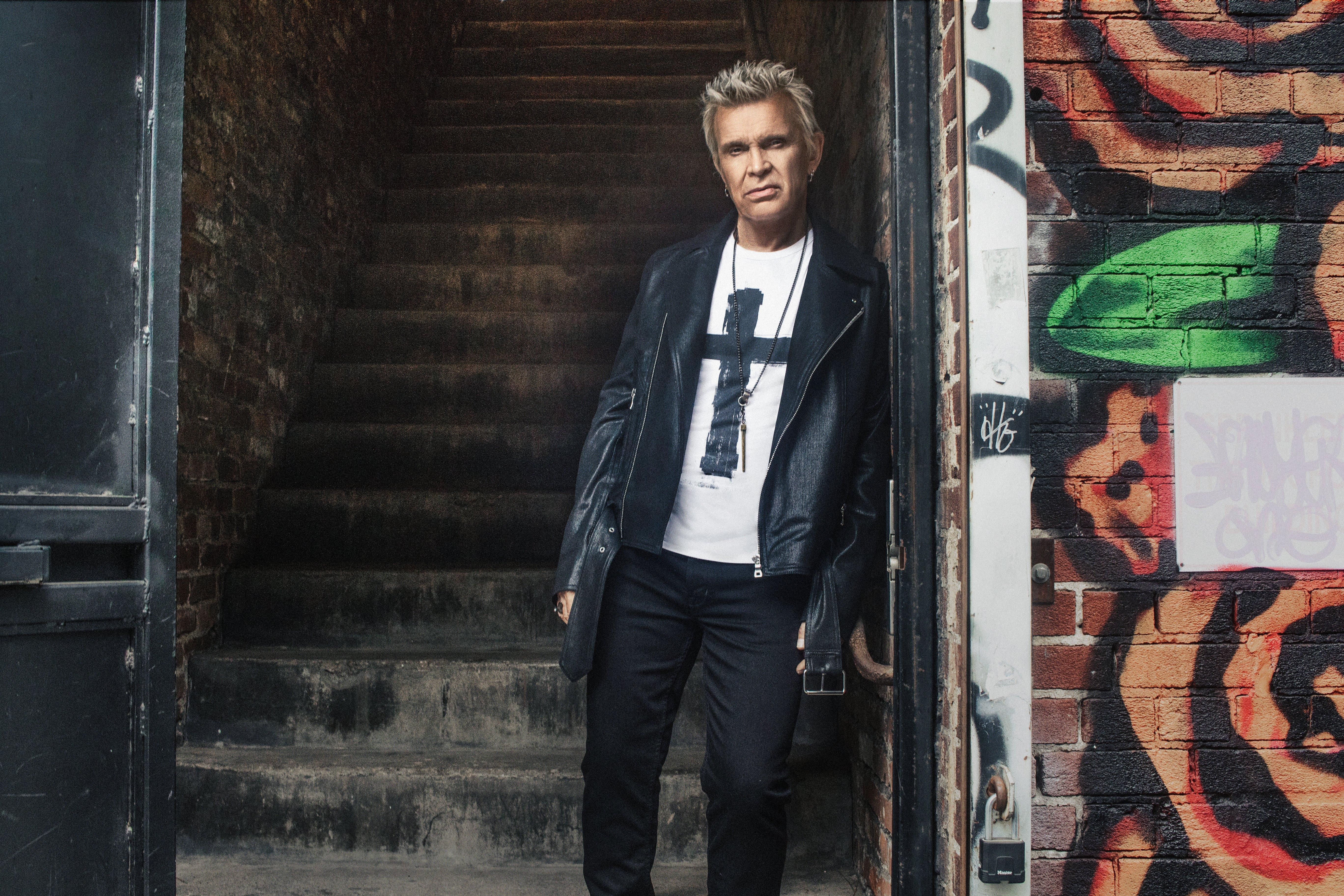
Living Legends is a series that spotlights icons in music still going strong today. This week, GRAMMY.com spoke with Billy Idol about his latest EP, Cage, and continuing to rock through decades of changing tastes.
Billy Idol is a true rock 'n' roll survivor who has persevered through cultural shifts and personal struggles. While some may think of Idol solely for "Rebel Yell" and "White Wedding," the singer's musical influences span genres and many of his tunes are less turbo-charged than his '80s hits would belie.
Idol first made a splash in the latter half of the '70s with the British punk band Generation X. In the '80s, he went on to a solo career combining rock, pop, and punk into a distinct sound that transformed him and his musical partner, guitarist Steve Stevens, into icons. They have racked up multiple GRAMMY nominations, in addition to one gold, one double platinum, and four platinum albums thanks to hits like "Cradle Of Love," "Flesh For Fantasy," and "Eyes Without A Face."
But, unlike many legacy artists, Idol is anything but a relic. Billy continues to produce vital Idol music by collaborating with producers and songwriters — including Miley Cyrus — who share his forward-thinking vision. He will play a five-show Vegas residency in November, and filmmaker Jonas Akerlund is working on a documentary about Idol’s life.
His latest release is Cage, the second in a trilogy of annual four-song EPs. The title track is a classic Billy Idol banger expressing the desire to free himself from personal constraints and live a better life. Other tracks on Cage incorporate metallic riffing and funky R&B grooves.
Idol continues to reckon with his demons — they both grappled with addiction during the '80s — and the singer is open about those struggles on the record and the page. (Idol's 2014 memoir Dancing With Myself, details a 1990 motorcycle accident that nearly claimed a leg, and how becoming a father steered him to reject hard drugs. "Bitter Taste," from his last EP, The Roadside, reflects on surviving the accident.)
Although Idol and Stevens split in the late '80s — the skilled guitarist fronted Steve Stevens & The Atomic Playboys, and collaborated with Michael Jackson, Rick Ocasek, Vince Neil, and Harold Faltermeyer (on the GRAMMY-winning "Top Gun Anthem") — their common history and shared musical bond has been undeniable. The duo reunited in 2001 for an episode of "VH1 Storytellers" and have been back in the saddle for two decades. Their union remains one of the strongest collaborations in rock 'n roll history.
While there is recognizable personnel and a distinguishable sound throughout a lot of his work, Billy Idol has always pushed himself to try different things. Idol discusses his musical journey, his desire to constantly move forward, and the strong connection that he shares with Stevens.
Steve has said that you like to mix up a variety of styles, yet everyone assumes you're the "Rebel Yell"/"White Wedding" guy. But if they really listen to your catalog, it's vastly different.
Yeah, that's right. With someone like Steve Stevens, and then back in the day Keith Forsey producing... [Before that] Generation X actually did move around inside punk rock. We didn't stay doing just the Ramones two-minute music. We actually did a seven-minute song. [Laughs]. We did always mix things up.
Then when I got into my solo career, that was the fun of it. With someone like Steve, I knew what he could do. I could see whatever we needed to do, we could nail it. The world was my oyster musically.
"Cage" is a classic-sounding Billy Idol rocker, then "Running From The Ghost" is almost metal, like what the Devil's Playground album was like back in the mid-2000s. "Miss Nobody" comes out of nowhere with this pop/R&B flavor. What inspired that?
We really hadn't done anything like that since something like "Flesh For Fantasy" [which] had a bit of an R&B thing about it. Back in the early days of Billy Idol, "Hot In The City" and "Mony Mony" had girls [singing] on the backgrounds.
We always had a bit of R&B really, so it was actually fun to revisit that. We just hadn't done anything really quite like that for a long time. That was one of the reasons to work with someone like Sam Hollander [for the song "Rita Hayworth"] on The Roadside. We knew we could go [with him] into an R&B world, and he's a great songwriter and producer. That's the fun of music really, trying out these things and seeing if you can make them stick.
I listen to new music by veteran artists and debate that with some people. I'm sure you have those fans that want their nostalgia, and then there are some people who will embrace the newer stuff. Do you find it’s a challenge to reach people with new songs?
Obviously, what we're looking for is, how do we somehow have one foot in the past and one foot into the future? We’ve got the best of all possible worlds because that has been the modus operandi of Billy Idol.
You want to do things that are true to you, and you don't just want to try and do things that you're seeing there in the charts today. I think that we're achieving it with things like "Running From The Ghost" and "Cage" on this new EP. I think we’re managing to do both in a way.
**Obviously, "Running From The Ghost" is about addiction, all the stuff that you went through, and in "Cage" you’re talking about freeing yourself from a lot of personal shackles. Was there any one moment in your life that made you really thought I have to not let this weigh me down anymore?**
I mean, things like the motorcycle accident I had, that was a bit of a wake up call way back. It was 32 years ago. But there were things like that, years ago, that gradually made me think about what I was doing with my life. I didn't want to ruin it, really. I didn't want to throw it away, and it made [me] be less cavalier.
I had to say to myself, about the drugs and stuff, that I've been there and I've done it. There’s no point in carrying on doing it. You couldn't get any higher. You didn't want to throw your life away casually, and I was close to doing that. It took me a bit of time, but then gradually I was able to get control of myself to a certain extent [with] drugs and everything. And I think Steve's done the same thing. We're on a similar path really, which has been great because we're in the same boat in terms of lyrics and stuff.
So a lot of things like that were wake up calls. Even having grandchildren and just watching my daughter enlarging her family and everything; it just makes you really positive about things and want to show a positive side to how you're feeling, about where you're going. We've lived with the demons so long, we've found a way to live with them. We found a way to be at peace with our demons, in a way. Maybe not completely, but certainly to where we’re enjoying what we do and excited about it.
[When writing] "Running From The Ghost" it was easy to go, what was the ghost for us? At one point, we were very drug addicted in the '80s. And Steve in particular is super sober [now]. I mean, I still vape pot and stuff. I don’t know how he’s doing it, but it’s incredible. All I want to be able to do is have a couple of glasses of wine at a restaurant or something. I can do that now.
I think working with people that are super talented, you just feel confident. That is a big reason why you open up and express yourself more because you feel comfortable with what's around you.
Did you watch Danny Boyle's recent Sex Pistols mini-series?
I did, yes.
You had a couple of cameos; well, an actor who portrayed you did. How did you react to it? How accurate do you think it was in portraying that particular time period?
I love Jonesy’s book, I thought his book was incredible. It's probably one of the best bio books really. It was incredible and so open. I was looking forward to that a lot.
It was as if [the show] kind of stayed with Steve [Jones’ memoir] about halfway through, and then departed from it. [John] Lydon, for instance, was never someone I ever saw acting out; he's more like that today. I never saw him do something like jump up in the room and run around going crazy. The only time I saw him ever do that was when they signed the recording deal with Virgin in front of Buckingham Palace. Whereas Sid Vicious was always acting out; he was always doing something in a horrible way or shouting at someone. I don't remember John being like that. I remember him being much more introverted.
But then I watched interviews with some of the actors about coming to grips with the parts they were playing. And they were saying, we knew punk rock happened but just didn't know any of the details. So I thought well, there you go. If ["Pistol" is] informing a lot of people who wouldn't know anything about punk rock, maybe that's what's good about it.
Maybe down the road John Lydon will get the chance to do John's version of the Pistols story. Maybe someone will go a lot deeper into it and it won't be so surface. But maybe you needed this just to get people back in the flow.
We had punk and metal over here in the States, but it feels like England it was legitimately more dangerous. British society was much more rigid.
It never went [as] mega in America. It went big in England. It exploded when the Pistols did that interview with [TV host Bill] Grundy, that lorry truck driver put his boot through his own TV, and all the national papers had "the filth and the fury" [headlines].
We went from being unknown to being known overnight. We waited a year, Generation X. We even told them [record labels] no for nine months to a year. Every record company wanted their own punk rock group. So it went really mega in England, and it affected the whole country – the style, the fashions, everything. I mean, the Ramones were massive in England. Devo had a No. 1 song [in England] with "Satisfaction" in '77. Actually, Devo was as big as or bigger than the Pistols.
You were ahead of the pop-punk thing that happened in the late '90s, and a lot of it became tongue-in-cheek by then. It didn't have the same sense of rebelliousness as the original movement. It was more pop.
It had become a style. There was a famous book in England called Revolt Into Style — and that's what had happened, a revolt that turned into style which then they were able to duplicate in their own way. Even recently, Billie Joe [Armstrong] did his own version of "Gimme Some Truth," the Lennon song we covered way back in 1977.
When we initially were making [punk] music, it hadn't become accepted yet. It was still dangerous and turned into a style that people were used to. We were still breaking barriers.
You have a band called Generation Sex with Steve Jones and Paul Cook. I assume you all have an easier time playing Pistols and Gen X songs together now and not worrying about getting spit on like back in the '70s?
Yeah, definitely. When I got to America I told the group I was putting it together, "No one spits at the audience."
We had five years of being spat on [in the UK], and it was revolting. And they spat at you if they liked you. If they didn't like it they smashed your gear up. One night, I remember I saw blood on my T-shirt, and I think Joe Strummer got meningitis when spit went in his mouth.
You had to go through a lot to become successful, it wasn't like you just kind of got up there and did a couple of gigs. I don't think some young rock bands really get that today.
With punk going so mega in England, we definitely got a leg up. We still had a lot of work to get where we got to, and rightly so because you find out that you need to do that. A lot of groups in the old days would be together three to five years before they ever made a record, and that time is really important. In a way, what was great about punk rock for me was it was very much a learning period. I really learned a lot [about] recording music and being in a group and even writing songs.
Then when I came to America, it was a flow, really. I also really started to know what I wanted Billy Idol to be. It took me a little bit, but I kind of knew what I wanted Billy Idol to be. And even that took a while to let it marinate.
You and Miley Cyrus have developed a good working relationship in the last several years. How do you think her fans have responded to you, and your fans have responded to her?
I think they're into it. It's more the record company that she had didn't really get "Night Crawling"— it was one of the best songs on Plastic Hearts, and I don't think they understood that. They wanted to go with Dua Lipa, they wanted to go with the modern, young acts, and I don't think they realized that that song was resonating with her fans. Which is a shame really because, with Andrew Watt producing, it's a hit song.
But at the same time, I enjoyed doing it. It came out really good and it's very Billy Idol. In fact, I think it’s more Billy Idol than Miley Cyrus. I think it shows you where Andrew Watt was. He was excited about doing a Billy Idol track. She's fun to work with. She’s a really great person and she works at her singing — I watched her rehearsing for the Super Bowl performance she gave. She rehearsed all Saturday morning, all Saturday afternoon, and Sunday morning and it was that afternoon. I have to admire her fortitude. She really cares.
I remember when you went on "Viva La Bam" back in 2005 and decided to give Bam Margera’s Lamborghini a new sunroof by taking a power saw to it. Did he own that car? Was that a rental?
I think it was his car.
Did he get over it later on?
He loved it. [Laughs] He’s got a wacky sense of humor. He’s fantastic, actually. I’m really sorry to see what he's been going through just lately. He's going through a lot, and I wish him the best. He's a fantastic person, and it's a shame that he's struggling so much with his addictions. I know what it's like. It's not easy.
Musically, what is the synergy like with you guys during the past 10 years, doing Kings and Queens of the Underground and this new stuff? What is your working relationship like now in this more sober, older, mature version of you two as opposed to what it was like back in the '80s?
In lots of ways it’s not so different because we always wrote the songs together, we always talked about what we're going to do together. It was just that we were getting high at the same time.We're just not getting [that way now] but we're doing all the same things.
We're still talking about things, still [planning] things:What are we going to do next? How are we going to find new people to work with? We want to find new producers. Let's be a little bit more timely about putting stuff out.That part of our relationship is the same, you know what I mean? That never got affected. We just happened to be overloading in the '80s.
The relationship’s… matured and it's carrying on being fruitful, and I think that's pretty amazing. Really, most people don't get to this place. Usually, they hate each other by now. [Laughs] We also give each other space. We're not stopping each other doing things outside of what we’re working on together. All of that enables us to carry on working together. I love and admire him. I respect him. He's been fantastic. I mean, just standing there on stage with him is always a treat. And he’s got an immensely great sense of humor. I think that's another reason why we can hang together after all this time because we've got the sense of humor to enable us to go forward.
There's a lot of fan reaction videos online, and I noticed a lot of younger women like "Rebel Yell" because, unlike a lot of other '80s alpha male rock tunes, you're talking about satisfying your lover.
It was about my girlfriend at the time, Perri Lister. It was about how great I thought she was, how much I was in love with her, and how great women are, how powerful they are.
It was a bit of a feminist anthem in a weird way. It was all about how relationships can free you and add a lot to your life. It was a cry of love, nothing to do with the Civil War or anything like that. Perri was a big part of my life, a big part of being Billy Idol. I wanted to write about it. I'm glad that's the effect.
Is there something you hope people get out of the songs you've been doing over the last 10 years? Do you find yourself putting out a message that keeps repeating?
Well, I suppose, if anything, is that you can come to terms with your life, you can keep a hold of it. You can work your dreams into reality in a way and, look, a million years later, still be enjoying it.
The only reason I'm singing about getting out of the cage is because I kicked out of the cage years ago. I joined Generation X when I said to my parents, "I'm leaving university, and I'm joining a punk rock group." And they didn't even know what a punk rock group was. Years ago, I’d write things for myself that put me on this path, so that maybe in 2022 I could sing something like "Cage" and be owning this territory and really having a good time. This is the life I wanted.
The original UK punk movement challenged societal norms. Despite all the craziness going on throughout the world, it seems like a lot of modern rock bands are afraid to do what you guys were doing. Do you think we'll see a shift in that?
Yeah. Art usually reacts to things, so I would think eventually there will be a massive reaction to the pop music that’s taken over — the middle of the road music, and then this kind of right wing politics. There will be a massive reaction if there's not already one. I don’t know where it will come from exactly. You never know who's gonna do [it].
Living Legends: Nancy Sinatra Reflects On Creating "Power And Magic" In Studio, Developing A Legacy Beyond "Boots" & The Pop Stars She Wants To Work With