
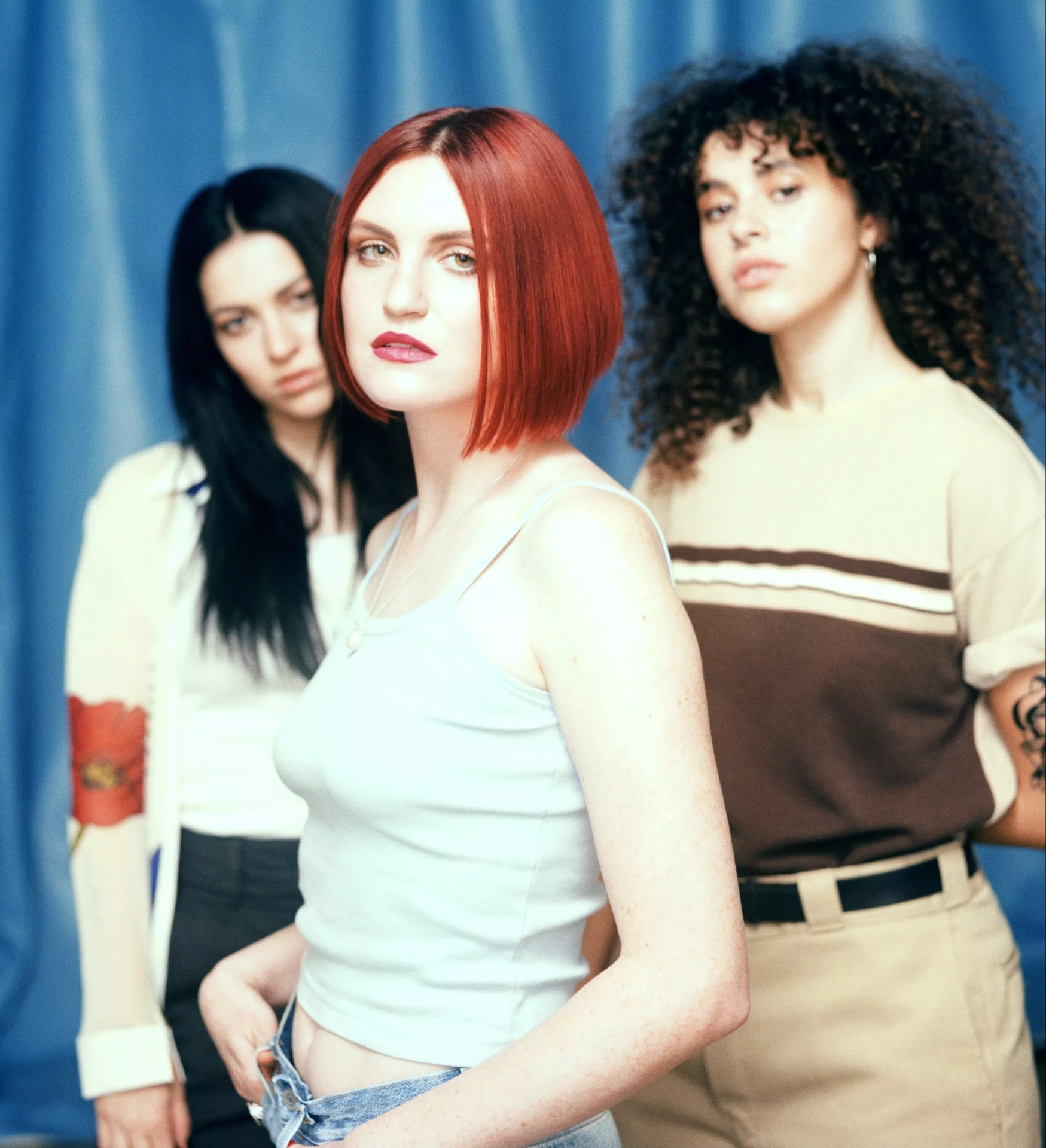
What is an artist meant to do with the state of the world in 2019? What might have once felt societally optimistic is now being challenged, and artists are left with the choice to either explore the political discomfort heart-first or write about everything but the tension and come across as indifferent and privileged. Los Angeles alt-pop trio MUNA find themselves facing this conundrum with a sense of urgency, turning inward as a result. They sound equally empathetic and defiant on their sophomore album, a fitting dichotomy for a record called Saves the World. The album deals well in parsing big questions of identity and gender politics in propellant synths and live percussion, introspection writ large across dancefloor-thumping grooves. In one album they have managed to suspend a feeling of optimism whilst yielding an album that links the world’s political reality with the human beings it has embodied.
Katie Gavin, Josette Maskin, and Naomi McPherson first joined forces while at college at the University of Southern California, where Gavin and Maskin were studying music and McPherson narrative studies and American studies & ethnicity. That academic background shines through, offering a clear voice in their storytelling, expanding their world to include primary resources, and deriving power from collaboration. But their 2017 debut, About U, and tour dates opening for Grouplove and Harry Styles translated that strength without any of the pretention that might suggest.
The three members of MUNA spoke with the Recording Academy about how to forge ahead in the face of catastrophic global warming, the struggles of women artists in the face of criticism and impostor syndrome and the process of narrowing down from dozens of songs to complete the superb Saves the World.
<iframe width="620" height="349" src="https://www.youtube.com/embed/lTreaPqgrPQ" frameborder="0" allow="accelerometer; autoplay; encrypted-media; gyroscope; picture-in-picture" allowfullscreen></iframe>
What is the one thing that connects you to your creativity when you're feeling disconnected from it?
Katie: After creating the record, it's a different creative process to now imagine what it’s going to be like when we play these songs live. We're trying to enjoy ourselves, and there’s something very mystical that connects us to the creative side. It's been in all of us as individuals since we were kids, and I think it's probably been in most humans—I'm a believer that there’s no such split between artists and non-artists. Everyone is creative, and we’re really lucky to have had lives where we've used our creative outlets for so long that it's a muscle that's really been exercised.
Josette: The logistics side to this, even though it does seem like a boring thing, is a different side of creativity. It just exercises the other side of our creative muscles, the two sides of the same creative coin. I think what drives us other than the mystical element of just loving the process of making music is that we've been endowed with a really intense sense of purpose. That comes directly from the people that we've picked up along the way as fans that are so supportive, and make us feel like what we are making is of deep importance, not just to us but to other people as well.
So when did you all realize that you were an artist? Having that contrast between knowing something mystically is inside us and also pursuing it are two completely different things.
Katie: Thinking of myself as an artist is probably something that just started in the last year, even though I've been literally writing songs since I was a kid. I started songwriting seriously when I was 10. I think it has a lot to do with the fact that I'm a woman. There's this idea that being a woman and being an artist are kind of incongruent. So, I've just come into that acceptance and that ownership really recently. I'm an overthinker and commitment-phobic, so I tried to do other things that just didn't really work for me. Josette and I were both studying music in school, so I think at that point, to a certain extent, we understood this is what we should be doing.
Josette: I knew from a young age that I wanted to be a musician, but feeling like an artist is a very hard thing because it's such a grandiose statement. That’s something that we all struggle with. A lot of this record was us coping with a sort of imposter syndrome. Being an artist comes with so much baggage like the media’s past representations of what an artist could be. But I've always known the one thing that I can do is be as unique of an individual, just trying to be myself wholeheartedly. Being creative is really a lifestyle choice. I don't think it is something that is limited to people who are in the creative sphere.
There's value in collaboration as well, I’d imagine. That can ease the tension. What did finding each other do for your creative process?
Naomi: We all struggle with a combination of knowing that you have something important to say and also feeling like a piece of trash. Being in a band is so incredibly emotionally helpful for us to be able to feel like it's something bigger than us. It's not about me, it's not about Katie, it's not about Josette. It's about MUNA, and that’s bigger than us—we hope.
I love the title, Saves the World. It calls to a past where we could really just have stories where a hero could defeat a singular villain and everything would turn out right. The world just feels so much messier. Do you feel like the world can be "saved"? Or is it just a matter of making more incremental and smaller changes?
Josette: The thing that I always think about is the hero's journey—Joseph Campbell. A villain arrives and a hero must go for this journey to defeat the villain. But it's a cycle of repetition. So that hero then becomes the next villain for the next hero. It’s this constant evolving process, with little steps forward. I don't think there's ever one thing to defeat, but this passing of time, the evolution or the spiral, the circle of life.
Naomi: We all identify with a lot of existentialist philosophy and the idea that you make meaning in your world, in a world that has no inherent meaning. The most radical thing that you can do in our current time is believe that the world can be saved, that we're not all f**ked. It's so easy to resign to a certain kind of very popular, accessible nihilism and tribalism that leads to all kinds of bad behavior. The world can be saved and we just wanted to make that statement and maybe give people a little bit of hope.
Katie: As a band, if we had a philosophy, it would somehow involve the concept that there's not really an enemy outside of yourself, and also that every human alive is doing the best that they can. And if you take that as the truth, then you start to really see how much trauma, pain and suffering there is in the world. And if everyone is doing the best they can, that means that a lot of people have suffered a lot and are damaged because of that. As a lyricist, this record for me was very much a journey of learning to accept that I was doing the best that I could, and to start to strain towards a higher version of myself. That requires relying on friends, learning how to have intimate relationships. We're trying to throw all of it into a pot and say, like, "This is all part of saving the world." But at the same time, we also do believe in miracles. The little individual choices matter, but we also live in a society, and just in terms of climate change, if we're really going to be able to make this planet habitable for humans for centuries to come, it can't just be the little guy making small changes. We also need people in positions with power and corporations that are really powerful to make changes.
"As a band, if we had a philosophy, it would somehow involve the concept that there's not really an enemy outside of yourself, and also that every human alive is doing the best that they can."
We had the promise of this utopia where technology was going to unite everybody and disintegrate borders, but maybe this all talks to our capacity for horror. As someone who has a platform and an audience, do you feel a sense of responsibility to talk about what's going on in the world around us?
Naomi: The thing that we talked about a lot during the making of the record was the concept that the most powerful art speaks to something universal but definitely reflects the time in which it was made or written. We didn't want to make a record devoid of context. Given our own personal journeys with our identities, we do feel a responsibility to try and be honest about the world that we live in. That may mean we’re not the most easily accessible band. There are a lot of hard pills to swallow in Katie's lyrics.
Josette: Anything that is true to the human experience is something that we're sometimes not necessarily in our society programmed to be able to swallow in terms of pop culture. It’s not what we're fed. And I think Katie's lyrics are her honest and true experience as a human.
Katie: Yeah, "Katie is just telling the truth with a capital T, and that's hard for everyone." [Laughs.] I would have thought that it was hard for people to hear songs that are from the depths of despair. But that's actually not that hard for people to process. I've found it particularly difficult to hear that no matter what has happened to me, I have a chance every day to grow and I'm not a victim of my circumstances. I always have some degree of choice and I always have support if I can figure out how to locate it and ask for it. I think the idea that we can become self-responsible, happy adults is f**king annoying. We don't really want to hear it. That's really funny. That's way scarier than the end of the world, you know? Then you are actually accountable for something.
There's this sense that pervades pop music of identification and connection with a community, which is wonderful and problematic all at once. That also leads me to your song, "Number One Fan," because there's this duality of connection and distance. It’s amazing for a kid in the middle of nowhere to connect with a whole world, but there can be real darkness in that obsession.
Katie: Oh my god, yeah. It’s kind of seductive, too. That can be really seductive for a band. When we are told we have good opinions and someone wants to write about it? It's seductive to the ego and we can become teachers without certification to teach. That was probably part of the reason why this record is so grounded in the personal; I'm thinking of a bowling lane when you have the bumpers up on the side. I have a big ego and I could easily slip onto my soapbox.
<iframe width="620" height="349" src="https://www.youtube.com/embed/Wqf-U_fibV0" frameborder="0" allow="accelerometer; autoplay; encrypted-media; gyroscope; picture-in-picture" allowfullscreen></iframe>
Escaping into other people's stories, or even your own, is really dangerous sometimes, especially as an artist. You recently tweeted about making a resource guide of books, films, and visual arts that influenced the record, which can work as a way to escape from that myopic trap.
Naomi: The idea behind the resource guide is about the intersectionality of art, and that nothing is devoid of context. The music that we make doesn't exist in a vacuum. If we have younger fans, ideally the books and philosophy could steer them in a cool direction. We're very avid learners, very much seeking the next hit of whatever's going to blow our mind. That happens all the time with all kinds of different creative mediums. It’s about giving the world of the album away to people to be able to make of it what they will.
In addition to music, when you’re stressed, what steers you into a calmer, better direction?
Katie: I started volunteering at a native plant nursery really close to where Naomi and Josette live. There's a lot of science around the positive effects of being in nature and specifically putting your hands in soil. Like most of us, I struggle with anxiety. I'll wake up and be like, "How do I stop climate change?" I made some friends who are in their 70s who have just been quietly going about their work for decades now. They’ll get excited about seeing a native bird or watching a tree that they grew years ago. That’s helped me a lot, and led me to start a little garden and compost next to my house. I’m also cooking for myself. I really need to learn how to be an adult every day, and that can be done in even simple tasks like learning how to make a pasta sauce from scratch.
Josette: Every day is a process because everyone is...not depressed, but on the edge of depression at any given moment. When we were on the last tour, I really hurt my knee, and like post-tour I did physical therapy. I've been finding a lot of peace in exercise. Naomi started doing yoga, and I do it occasionally, as well as meditation, which has really been helpful. I love cooking as well. If I'm going to make soup, I'm going to soak the beans and make a vegetable stock, things that make it so you have to actually go through the whole process of creation, creativity, and focus. That connects me to myself, which is the hardest thing to do when feeling anxiety in any way.
Naomi: It’s kind of like wabi sabi, right? The Japanese idea, accepting the beauty that is in the imperfect, and just trying your f**king best and being proud of yourself. It's really hard for the three of us to be okay with feeling proud of ourselves. I think we're all in much better places, probably because of having to make this record and do the internal work that it took to make it happen. It led to a general acceptance of ourselves of just trying to be a good person. That's all you can really do. Just don't be too hard on yourself. This sh*t is real. It's hard out here.
The pattern that seems to tie you three together is finding little joys in life as a way to assist in the creative process—living and being curious as opposed to just guzzling content.
Katie: I'm smiling so hard right now hearing you like synthesize this stuff, it's so epic. You're talking about creative living: living as a creative rather than living as a consumer. Does that make sense?
Yeah. Like your music, it requires a willingness to express yourself, but leaves open room for a lot of questions. How do you make sure you are retaining a unique identity, while making accessible music?
Josette: There were maybe 60 songs created in the making of this record. Those songs didn't make the cut—not because they weren't good songs, but maybe they weren't made for what we were going for in this exact moment in time. Everything has its value. I don't think it's limited to accessibility, but instead the idea of what MUNA is in that moment. The album is the structure and then we put everything into that box.
Naomi: What binds the three of us is an unspoken understanding when something is good. There is a sort of mystical, spiritual element of it where everyone connects. We all have the pop music virus in our brains. There are certain things that are just really pleasant for us, but also Katie is such an amazing lyricist that there is a level of intellect and cleverness to the songs that makes it easy to build a world around what she's saying.
You all are clearly interested in and express the complexity of identity and a feminist politics without that being a definition of who you are or what your art is. Does the current political chaos and darkness make that a more difficult line to walk? Did you feel an extra push to have your politics become your identity?
Naomi: I don't think that we necessarily feel an internal pressure to be politicized because it’s within the fabric of the band itself. It's both implicit and explicit. It's worked into the tapestry of the art in general. But we do feel we need to speak about what's going on in our time in a way that isn't inflammatory or contributing to the contentious style of conversation and rhetoric that happens. Obviously we are of the political left and it's a scary time, and that's a very real thing that we think about all the time. We'll see what happens when we start performing the songs and how people are reacting to them, because then maybe they'll take on a different political implication depending on what happens.
Katie: We did feel a pressure, to a certain extent, because there's so much to stick up for right now. There's so much at stake and it can feel extremely urgent. One of the biggest tragedies of our time is the fact that the political realm is completely devoid of spirit and heart. There's no room to be a real person. There's so much dehumanization in the political realm. One focal point for us is to humanize it, to put some spirit back into the world.
