
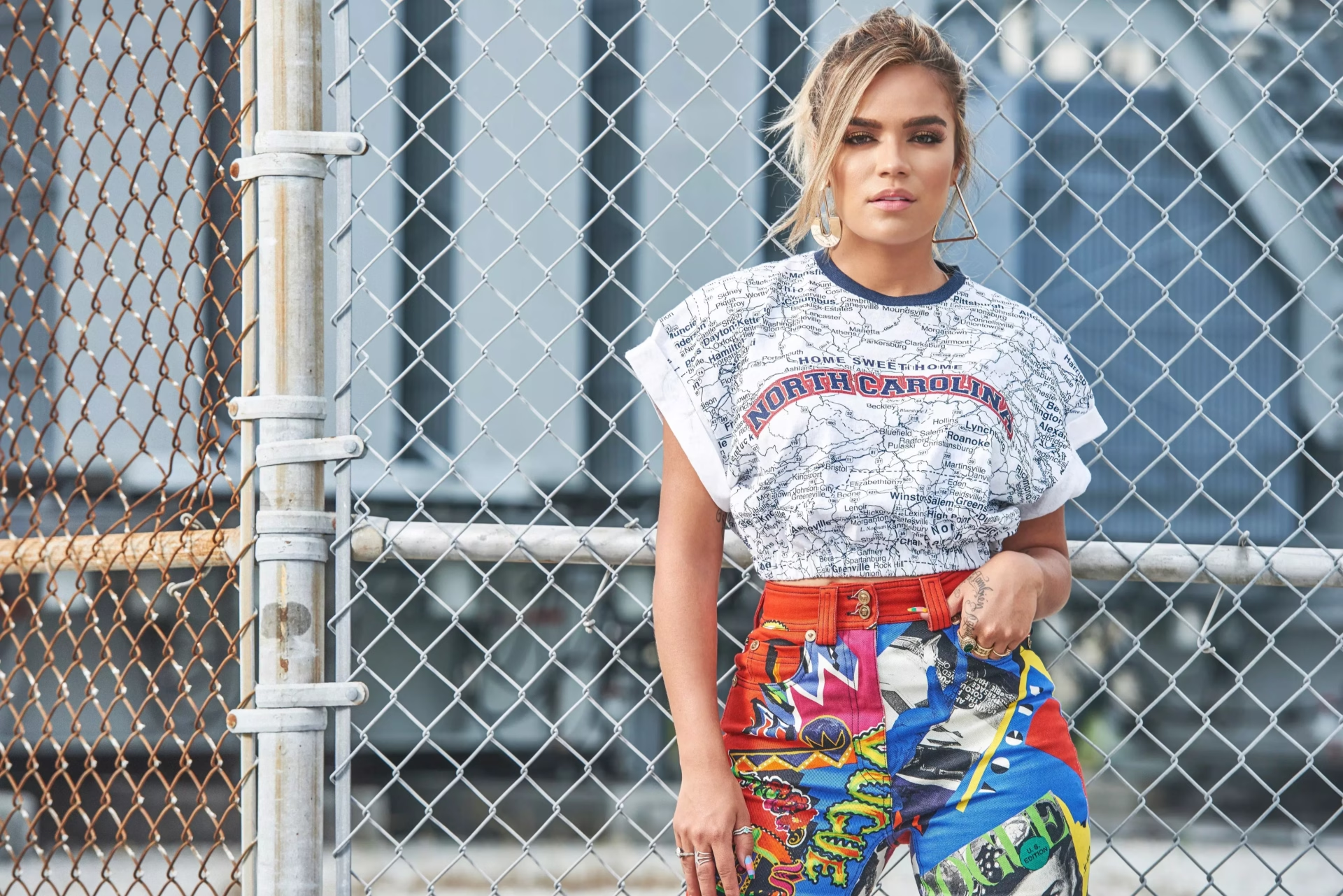
Karol G is "200 percent" sure that women are gaining visibility in reggaeton.
An urban Latin artist, the 28-year-old is undeniably one of the brightest stars in her genre, with more than 15 million followers on Instagram, four million followers on Spotify, 600k-plus followers (and 183 million lifetime streams) on Pandora, and placement on Apple Music's Dale Play! Latin urban playlist for International Women's Day. And that’s not counting her three No.1 hits on the Latin Airplay Chart and a Best New Artist award at the 19th Annual Latin GRAMMYs in 2018.
There’s little doubt that Karol G is thriving. Her take on reggaeton, a genre that generally borrows from dancehall, reggae and hip-hop, features a pop fusion and empowering lyrics directed toward a female audience. But her success didn’t happen overnight; it’s been years in the making.
"A lot of people may know me for my music now," Karol G says during a stop in Mexico for the tour she's doing with fellow urban artist and boyfriend, Anuel AA. "It took me almost 14 years to get where I am, and it was really hard."
REGGAETON’S HISTORY OF GENDER IMBALANCE
Research supports that female artists in Latin music are scarce. According to Dr. Stacy Smith and USC's Annenberg Inclusion Initiative, who analyzed the top 150 songs from the Billboard Hot Latin Songs Chart between 2015–2917, the ratio for every 10 male artists was one female artist. In 2015, six percent of artists were women in the top 150 songs of the chart, while 2017 saw a rise to 13 percent. In terms of songwriting, women represented 3.8 percent during the three years analyzed.
"Female artists are few and far in between… I think that is a problem in Latin [that's] always been there," says Head of Latin Music at Pandora Marcos Juárez.
WOMEN DON’T SELL(?)
According to female reggaeton artists, the roadblocks they face have everything to do with gender.
“From the moment I decided to go by ‘Karol G,’ I began doing reggaeton or urban Latin music, and because there were no women, they would say [that] women couldn't do it or because ‘You're a woman,’ this or that,” says Karol. “Because you're a woman they think your values and your dignity, become interchangeable, and they offer you things at the cost of other things.”
Reggaeton has been a male-dominated genre for years. And Latin trap, the Spanish-language version of the South's trap music and another rising sub-genre of urban Latin music, is not much different.
In Puerto Rico, reggaeton began as an underground scene (many attribute the birth of reggaeton to Panama and artists like El General) in the early and mid-2000s. Eventually, what is now known as “classic reggaeton,” expanded outside of the island to other parts of Latin America and parts of the mainland U.S., where there were more young Latino-Americans.
But a recent resurgence of the genre, led by artists like J Balvin and Luis Fonsi and Daddy Yankee's 2017 Latin-pop smash "Despacito," which reached No. 1 on the Billboard 100 with a version featuring Justin Bieber, has taken the genre to a new global level. And thanks to the viral nature of the internet, people in many more parts of the U.S. and world, English speaking or not, are listening to reggaeton's more "marketable" version of itself.
How powerful has the genre become? In 2018, only two of YouTube's top 10 most-watched videos were in English. The rest were in Spanish, and each had at least one urban music artist attached to it. With over 1.5 billion users, the platform is the most popular to stream music, according to Forbes. Only one of those eight songs featured women, "Sin Pijama" by Natti Natasha and Becky G.
As Remezcla points out, women have been instrumental in the Latin Urban genre, one of those artists being Puerto Rico's Ivy Queen who has been a trailblazer for women empowerment with anthems like "Quiero Bailar," which tackles women's rights and objectification. So why has it been so tricky for women to gain visibility in the market?
<iframe width="620" height="349" src="https://www.youtube.com/embed/zEf423kYfqk" frameborder="0" allow="accelerometer; autoplay; encrypted-media; gyroscope; picture-in-picture" allowfullscreen></iframe>
Natti Natasha, a Latin urban singer/songwriter who had her first hit alongside reggaeton icon Don Omar in 2012 with "Dutty Love," was initially told by label executives that women simply don’t sell in her genre.
"Any [female] artist that is trying to make it out there is probably struggling right now,” she says. “And then being a woman is like, I had to go places and show what I had and they were like, 'We like it. It's good music, but women don't sell. They're not going to listen to you. So us investing our time and investing all we have in you, it's probably not gonna come back.’”
While "Dutty Love" peaked at No. 1 on Billboard's Latin Pop Songs Chart, the success was short-lived for Natasha. But things turned around years later; Natti Natasha is YouTube's most watched female artist and overall one of the top ten most-watched acts on the platform of 2018.
BREAKING THE GLASS CEILING BY BANDING TOGETHER
With a growing interest in Latin urban music, labels are closing in on the imbalance. Universal, home to Karol G, and Sony, who distributes Natti Natasha and where Becky G and Jennifer Lopez are signed, recently told Billboard that things are beginning to look different for women in urban Latin.
“There was definitely an opening for women [in 2018], ”Executive Vice President Latin America/Iberian Peninsula for Universal Music Angel Kaminsky said. "There has been a surge like we’ve never seen before of female acts from many different countries with lots of attitude and potential. These girls are writing at a younger age, and the material reflects their stories and their lives, leading to bigger engagement.”
"We made a commitment to bring diversity to the Latin music landscape, and this year we’ve had a record number of hits by female acts,” says Nir Seroussi, President of Sony Music U.S. Latin also told Billboard.
While the industry may be more welcoming women now, there was a time where Natti Natasha says women felt pitted against each other.
"They used to want women to compete,” she says. “Don't know why, but it was just like an automatic thing. Once you understand that is not the way to go, you understand why that happens, why they do it. You do all the opposite, and you get together and you make this happen. You prove to people that it's not a competing thing. It's a collaborating situation.”
RELATED: Latin Pop Performer Natti Natasha Takes Center Stage On 'IlumiNATTI'
Collaboration among Latin urban women is absolutely on the rise, agrees Latin Curator at Pandora Leticia Ramirez, which has helped them gain visibility. "I think there is definitely a sense within the music community with female artists that there needs to be a level of support for one another versus a comparison of one another. I think that is allowing more experiences and opportunities with amongst themselves to do things."
Cross-promotion among Latin artists is already a widely utilized practice. During a tribute to Daddy Yankee at Premios Lo Nuestro this past year, the reggaeton figurehead thanked his male colleagues for supporting each other. According to Juárez, public support, like the sort offered by Yankee, is precisely what helps Puerto Rican performers be successful.
"I think what's really unique about Puerto Rican artists is the way they've all put each other on … Puerto Ricans have set the template for collaborating and co-signing artists, and helping bring people up. You see that over and over and over."
Dr. Stacy Smith found in her research that many Laitn chart-toppers are Puerto Rican.
COMBATING "MACHISMO" IN LATIN CULTURE
But, as Juarez points out, there may be more subtle, industry-wide obstacles that deter women’s success in this arena. He notes that listeners on Pandora, which allows users to thumb up or thumb down artists, are not always receptive to female artists.
"I think part of it is probably culture … machismo is real, and I think that is definitely part of it," he says. "I'll tell you what, on [the] Reggaeton de Hoy [station,] it's really hard to put women in there, because people just don't ... number one, there's not a ton of [female] artists [out there]. It's not to say that there is none, I mean, there definitely are some artists who are killing it. But there's not a ton, and people react adversely to it still."
Ramirez sees the industry's recent push for female artists and believes that it may be listeners who need to become more supportive of female artists.
"They are publicists. They're pushing. They're communicators. They're making s**t happen. So I don't think it's something that's dictated from the industry. I think it could be cultural, quite frankly," she says. "I think that for some reason the consumer isn't as easily supportive of a female artist as they are a man. There's still that negative comparison to women … With men, a lot of things are excused. You know? … I do think there is that part of it. I think that that could kind of impact women and how far they can go in the music industry."
RELATED: Ozuna, J Balvin & More Pay Tribute To Daddy Yankee At Premio Lo Nuestro
MORE WOMEN IN THE STREAMING MIX
Juarez says digital streaming platforms, along with labels, could be doing more. Dr. Stacy Smith agrees. At a panel called Women In The Lead, held during Billboard Latin Week 2018, asserted that it’s ultimately up to streaming platforms to create desire for an audience. "It's not about what the audience wants, it’s what these companies are willing to supply to create the desire amongst listeners."
But what does that look like? An all-female playlist or radio station? Juarez says "all-female" content may not be the best solution.
"I think you run the risk of making [women] ‘other,’” he says. “It's much more beneficial to integrate [women] and have it seem natural as part of just a listening experience. I think more and more, we're getting to that," he says.
“We have a station, an effort called El Pulso on Pandora, which we launched last year, sort of like a franchise Latin effort. The idea there was to really embrace this popular Latin movement that our listeners are showing us that is important and impactful for them. But then we're also trying to be predictive and trying to include up-and-coming artists, and a lot of those artists are females."
One thing streaming platforms can do, Juarez says, is keep women artists in front of audiences in an organic way.
"I think within that branded listening experience, there're opportunities to just keep ... Not force-feeding people, but just keep trying, you know? Keep putting it in front of people," he says.
While Apple Music, Spotify and Pandora are all establishing ways to organically integrate women into their Latin music playlists and stations, Karol G says another way females need support is through the acceptance of their lyrics.
<iframe width="620" height="349" src="https://www.youtube.com/embed/8-mloCL49vs" frameborder="0" allow="accelerometer; autoplay; encrypted-media; gyroscope; picture-in-picture" allowfullscreen></iframe>
"The only limit I see at the moment is people accepting our lyrics … We have songs about love, about falling out of love … I want to be able to talk about anything and everything because I am human … I think there needs to be a little more equality in that aspect," say says.
But despite the challenges, Karol G believes this moment for women in reggaeton is more than a trend; it’s a genuine movement that’s showing no signs of slowing down.
"There was a time in which there weren’t feminine faces,” she says. “Now that door is open, and we're coming in. Not one, not two, but many of us. That makes people's curiosity grow. People now want to hear our side of the story. They want to know where we've been and how we did it.”
"On Location: Miami": Lary Over Talks About Latin Trap Origins
