
About Madonna
"I'm tough, I'm ambitious and I know exactly what I want. If that makes me a b****, OK."
- Born Madonna Louise Ciccone on Aug. 16, 1958, in Bay City, Michigan
- Madonna's second album, 1984's Like A Virgin, fueled by a steamy performance of the title track at the 1984 MTV Video Music Awards, became her first No. 1 album. "Like A Virgin" netted the Material Girl her first chart-topping single on the Billboard Hot 100.
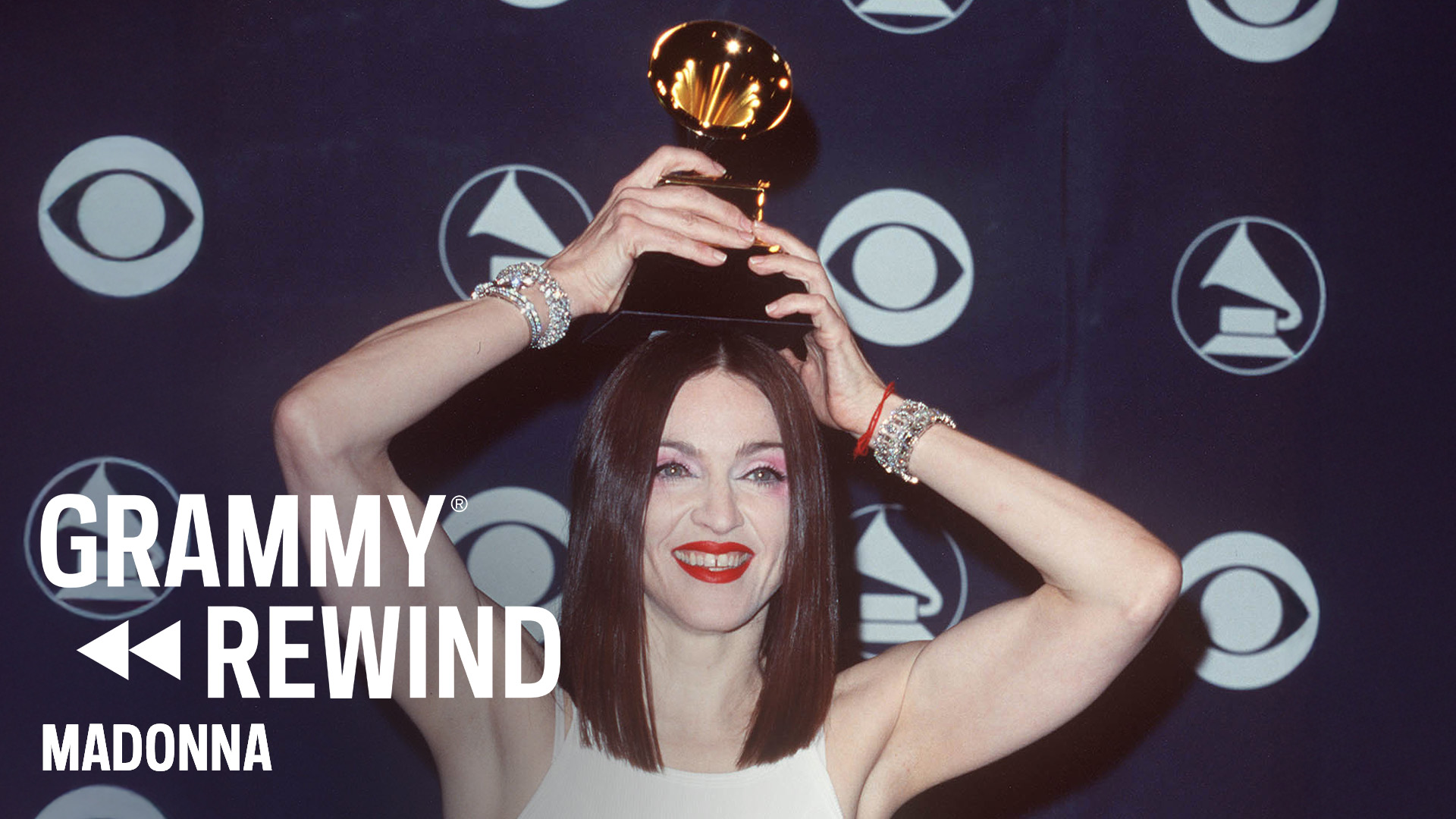
- Madonna won her first GRAMMY for Best Music Video, Long Form for Madonna — Blonde Ambition World Tour for 1991. She won her first audio category award for Best Dance Recording for "Ray Of Light" for 1998.
- Madonna helped boost the career of GRAMMY-winning rappers the Beastie Boys when she had them open during her The Virgin Tour in 1985.
- Madonna has supported a wide range of charities, including American Foundation for AIDS Research and her own Raising Malawi, a nonprofit that supports community-based organizations that provide vulnerable children and caregivers in Malawi with food, clothing, shelter, education, and medical care.
Madonna: A Complete Grammy Legacy and Career Overview
Madonna Louise Ciccone — known to the world simply as Madonna — is one of the most decorated, influential, and commercially successful recording artists in the history of popular music. Born on August 16, 1958, in Bay City, Michigan, she relocated to New York City in 1978 with just $35 in her pocket and an unshakeable ambition to become a star. Within five years, she had become one of the defining voices of a generation. Over four decades later, she remains a dominant cultural force with no serious rival for the title of the world's best-selling female recording artist of all time, with global record sales surpassing 300 million.
Early Career and the Rise of an Icon
Madonna's debut self-titled album arrived in 1983, producing dance-floor hits that announced a new kind of pop star — one who was self-produced, self-styled, and completely in control of her narrative. But it was her second studio album, Like a Virgin (1984), that transformed her from a rising star into a global phenomenon. Her electrifying performance of the title track at the inaugural MTV Video Music Awards — writhing across the stage in a wedding dress — became one of the most discussed moments in pop culture history and permanently established her as an artist willing to challenge boundaries. The album debuted at No. 1 on the Billboard 200 and remained there for three weeks, while the title single topped the Billboard Hot 100 for six consecutive weeks.
This era also produced Material Girl, cementing a persona that was simultaneously ironic and aspirational — a savvy commentary on consumerism dressed in sequins and diamonds. Madonna was not simply making music; she was making meaning.
Grammy Nominations and Wins: A Detailed Record
Madonna has received 28 Grammy nominations across her career, winning 7 awards — a record that reflects both peer recognition and the Recording Academy's acknowledgment of her sustained creative output across multiple genres.
Her first Grammy win came at the 33rd Annual Grammy Awards (1991) for Best Music Video, Long Form, for Blonde Ambition World Tour Live — a recognition of her status as a visual and performance innovator, not just a recording artist. The Blonde Ambition tour itself is widely cited by critics and artists alike as one of the greatest concert tours in history, influencing the production values and storytelling ambitions of live performance for decades.
Her most significant Grammy recognition came at the 41st Annual Grammy Awards (1999), when Ray of Light earned her four nominations including Album of the Year and Record of the Year, and she took home the award for Best Dance Recording. The album, produced in collaboration with William Orbit, represented a dramatic artistic evolution — fusing electronica, ambient music, and introspective lyricism in a way that surprised critics and delighted fans. Ray of Light stands today as one of the most critically acclaimed pop albums of its era.
At the 49th Annual Grammy Awards (2007), Confessions on a Dance Floor won Best Dance/Electronic Album — her second win in an audio category and confirmation that, well into her third decade of recording, she was still capable of releasing landmark work. The album is widely considered one of the finest dance records of the 2000s, with Hung Up (built on a sample from ABBA's Gimme! Gimme! Gimme!) becoming one of the fastest-rising singles in chart history, debuting at No. 1 in 41 countries simultaneously.
Her Best Music Film Grammy for The Confessions Tour (50th Annual Grammy Awards, 2008) further cemented her reputation as a live performance artist of the highest order — an artist whose concert films stand alone as cinematic achievements.
Cultural Impact and Musical Evolution
What makes Madonna's Grammy story unique is not just the wins, but the remarkable range of categories in which she has been nominated. From Best Female Pop Vocal Performance (first nominated in 1986 for Crazy For You) to Best Dance/Electronic Recording, Best Music Film, Best Pop Vocal Album, Record of the Year, and even Best Song Written for Visual Media, her nominations map a career that has never stayed still. She has collaborated with the era's defining producers at every stage — Nile Rodgers, Patrick Leonard, William Orbit, Mirwais Ahmadzaï, Stuart Price, Pharrell Williams, Diplo, and more — adopting and often anticipating the sounds that would define each decade.
She is, above all else, an artist who shapes culture rather than following it. Her Like a Prayer video in 1989 ignited national conversation about religion and race. Her Vogue single and the Truth or Dare documentary brought ballroom culture and LGBTQ+ identity to mainstream audiences years before the broader culture was ready for that conversation. Her Erotica album and Sex book in 1992 confronted taboos around female sexuality with a directness that was controversial then and recognized as groundbreaking now.
Philanthropy and Advocacy
Beyond music, Madonna has used her platform to advocate for causes close to her heart for more than 40 years. She was among the earliest and most vocal celebrity advocates for AIDS awareness during the crisis of the 1980s and 1990s, raising funds and consciousness when the disease carried enormous stigma. She co-founded Raising Malawi, a nonprofit organization dedicated to supporting vulnerable children and caregivers in one of the world's least-resourced nations, providing access to food, shelter, education, and medical care. Her philanthropic work has included support for the American Foundation for AIDS Research (amfAR), LGBTQ+ rights organizations, and education initiatives across Sub-Saharan Africa.
Legacy in the Recording Academy's History
Madonna's relationship with the Grammy Awards stretches from 1986 to 2010 — a 24-year span of nominations that is, in itself, a testament to longevity almost unparalleled in popular music. Few artists have remained relevant, commercially dominant, and artistically ambitious across such an extended period. From the synth-pop of the mid-1980s to the electronic experimentation of the late 1990s, the disco revivalism of the mid-2000s, and beyond, she has navigated every shift in the musical landscape not by chasing trends but by helping to create them.
For the Recording Academy, Madonna represents the clearest possible embodiment of what the Grammy Awards celebrate: artistic excellence, creative courage, and enduring impact on music and culture alike.
All Grammy Awards and
Nominations for Madonna
The Grammys are more than just Awards


Music Advocacy

Ready to Reach Out? We’re Ready to Listen.
Madonna Videos


Sign Up For
The Gramophone
Socials