
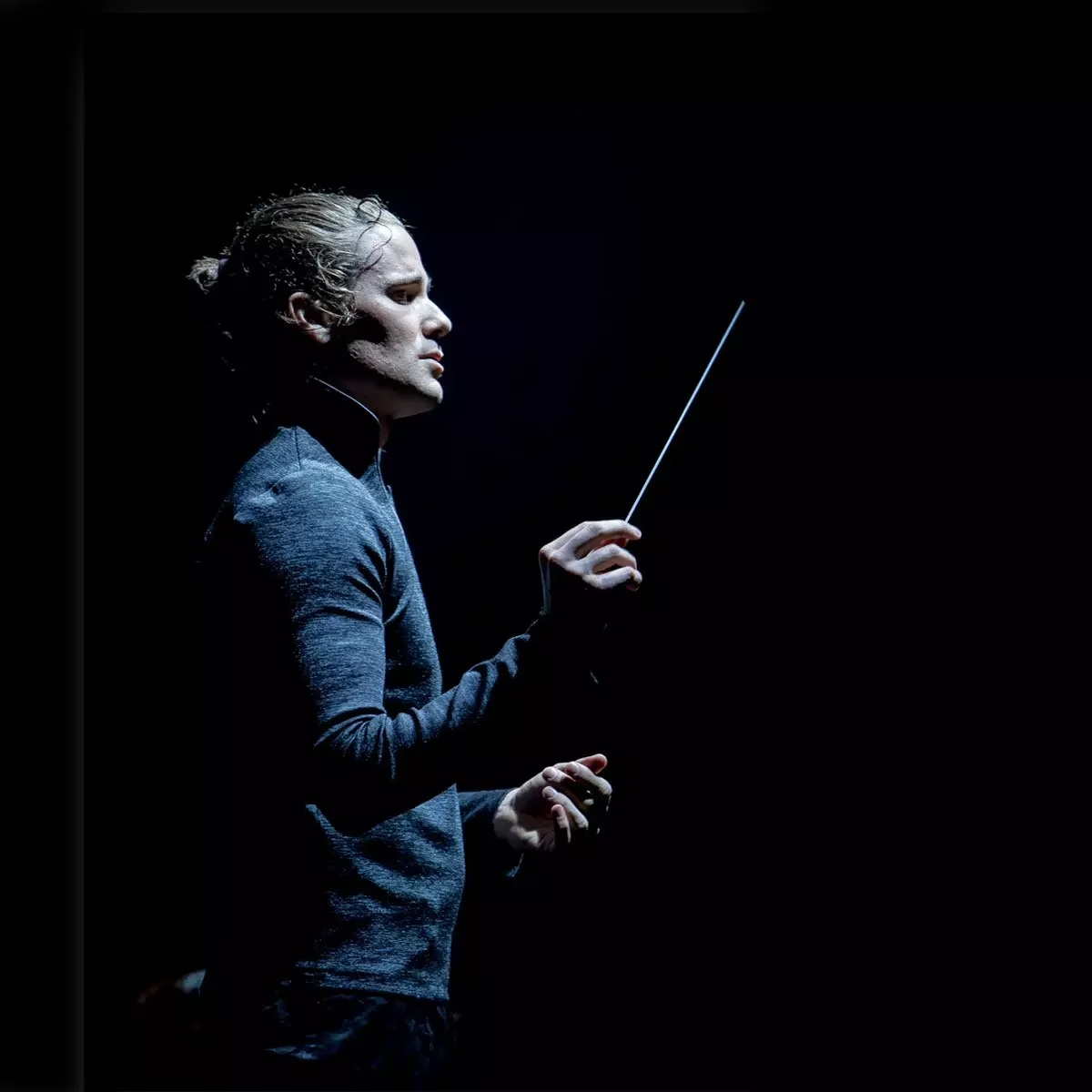
In an era where artists are as liberated as ever to blend genres, there are few combinations left unexplored, a fact that makes Steve Hackman's Stereo Hideout presentation of "Brahms V. Radiohead" all the more novel. With the help of a 55-piece orchestra and three fantastic guest vocalists, Hackman gave a one-night-only performance of the piece at the majestic Kings Theatre in Brooklyn, N.Y., on May 19.
<iframe width="620" height="349" src="https://www.youtube.com/embed/W2NHnhCGIV0" frameborder="0" allow="autoplay; encrypted-media" allowfullscreen></iframe>
As the show's re-composer, arranger and conductor, Hackman created a musical monster, melding Johannes Brahms' iconic romantic masterpiece "First Symphony" with Radiohead's electro-rock watershed album, OK Computer, which won for Best Alternative Music Performance and was nominated for Album Of The Year at the 40th GRAMMY Awards.
Before getting to the main event, Hackman treated his audience to a dynamic first set full of bold musical reinventions. One of the highlights was Hackman's daring treatment of what he called one of his favorite Radiohead songs, "Idioteque," from Kid A, the GRAMMY-winning 2000 follow-up to OK Computer. Drafting from the song's scrappy, pulsating rhythms, Hackman made full use of his orchestra to flesh out something new from the familiar melodies, an accomplishment he'd make time and time again over the course of the evening.
Hackman also brought out special guests, Time For Three, an uber-talented trio of musicians who have created an all-new vehicle for connecting classical music with modern pop and vice versa. They performed a song Hackman wrote for them called "Vertigo," leaving the crowd stunned by their virtuosic showmanship.
The night's first half showcased Hackman's versatility, ambition and collaborative aptitude, working in everything from traditional rock band instrumentation, an incredible guest rapper and his own adept singing, all joining in with the orchestra seamlessly enough to make it work, but imaginatively enough to make the audience understand they were witnessing something unique.
<iframe allow="autoplay *; encrypted-media *;" sandbox="allow-forms allow-popups allow-same-origin allow-scripts allow-top-navigation-by-user-activation" style="padding:0;width:660px;height:450px;max-width:100%;border:none;overflow:hidden;background:transparent;" src="https://embed.music.apple.com/us/album/ok-computer/1097861387"></iframe>
After intermission, and before the main program of "Brahms V. Radiohead" commenced, Hackman encouraged the audience to think differently about what they were about to hear.
"A lot of people would say that music like this doesn't belong together, possibly, and they would say there are barriers between these musics, and they're categorized into sort of artificial different camps," said Hackman. "In my mind, and I think in the mind of many of the musicians on this stage, those barriers are artificial, and they're in our minds, and if you can't see them, are they really there? Something to think about as we play 'Brahms V. Radiohead.'"
From the opening notes of "Airbag," the symphonic treatment of Radiohead's material felt familiar and melodic, and as Brahms' "First Movement" entered, the timbre of the orchestra promptly melded the two works sonically, setting the stage for an hour of drifting back and forth between styles, genres and eras.
Hackman led a gorgeous version of "Paranoid Android" that barreled from its soaring melodic beginning into one of the night's most cathartic moments, with strings swelling, percussion pulsing and the vocals devolving into near-screams before the entire orchestra opened up into the song's dreamy outro. The song felt at home in the hands of the classical format.
The orchestra also took naturally to Hackman's rich arrangement of "Exit Music (For A Film)," and the three incredible featured vocalists — Kéren Tayár, Andrew Lipke and Will Post — cascaded through the three-part vocal harmony of "Karma Police" with commanding skill. While Brahms' material may have been more of a natural fit for the orchestra, it was interweaved into OK Computer as to take on its character without losing any of the composer's original passion and care.
<iframe allow="autoplay *; encrypted-media *;" sandbox="allow-forms allow-popups allow-same-origin allow-scripts allow-top-navigation-by-user-activation" style="padding:0;width:660px;height:450px;max-width:100%;border:none;overflow:hidden;background:transparent;" src="https://embed.music.apple.com/us/album/brahms-symphony-no-1/156356507"></iframe>
In fact, Hackman spoke about how Brahms painstakingly composed his first symphony, taking more than two decades to carefully craft it under heavy influence from Ludwig van Beethoven and the pressure of being heralded as his successor.
"You can hear that pressure woven into every note in this symphony," said Hackman. "In Radiohead's case, the themes of OK Computer, they talk about how as the world becomes more digital and the world becomes more connected as far as information goes, we actually become more disconnected. They talk about emotional isolation. They talk about disasters politically at that time, and again, every lyric and note is channeled with those energies, so I think you'll find that they really have that in common, so the marriage is really possible."
"I find that both of these musics are innovations within convention." — Steve Hackman
Hackman and Stereo Hideout have built a reputation for connecting composers of the past with the pop music of today, including compositions such as "Bartók V. Björk," "Copland V. Bon Iver" and "Beethoven V. Coldplay," all aimed at changing the way we listen to and understand music in the context of history.
"Stereo Hideout is all about originality, boldness, virtuosity, and disruption," says Hackman. "It is its own new hybrid strand of music informed by masterpieces of the past but electrified by the techniques of today."
Set against the gorgeous backdrop of the newly remodeled King Theatre — complete with its soaring curved ceilings, ornate walls, gorgeous wood paneling, and a glazed terra-cotta ornamental façade — "Brahms V. Radiohead" provided music fans a new way of listening to two of history's greatest musical works outside the confines of their places on a timeline. Hackman re-composed and compiled something so creative and special yet so natural and real.
And if Brahms and Radiohead aren't your thing, don't worry, Stereo Hideout have you covered.
"We will be back in the fall with Stereo Hideout," says Hackman. "Tchaikovsky versus Drake."
