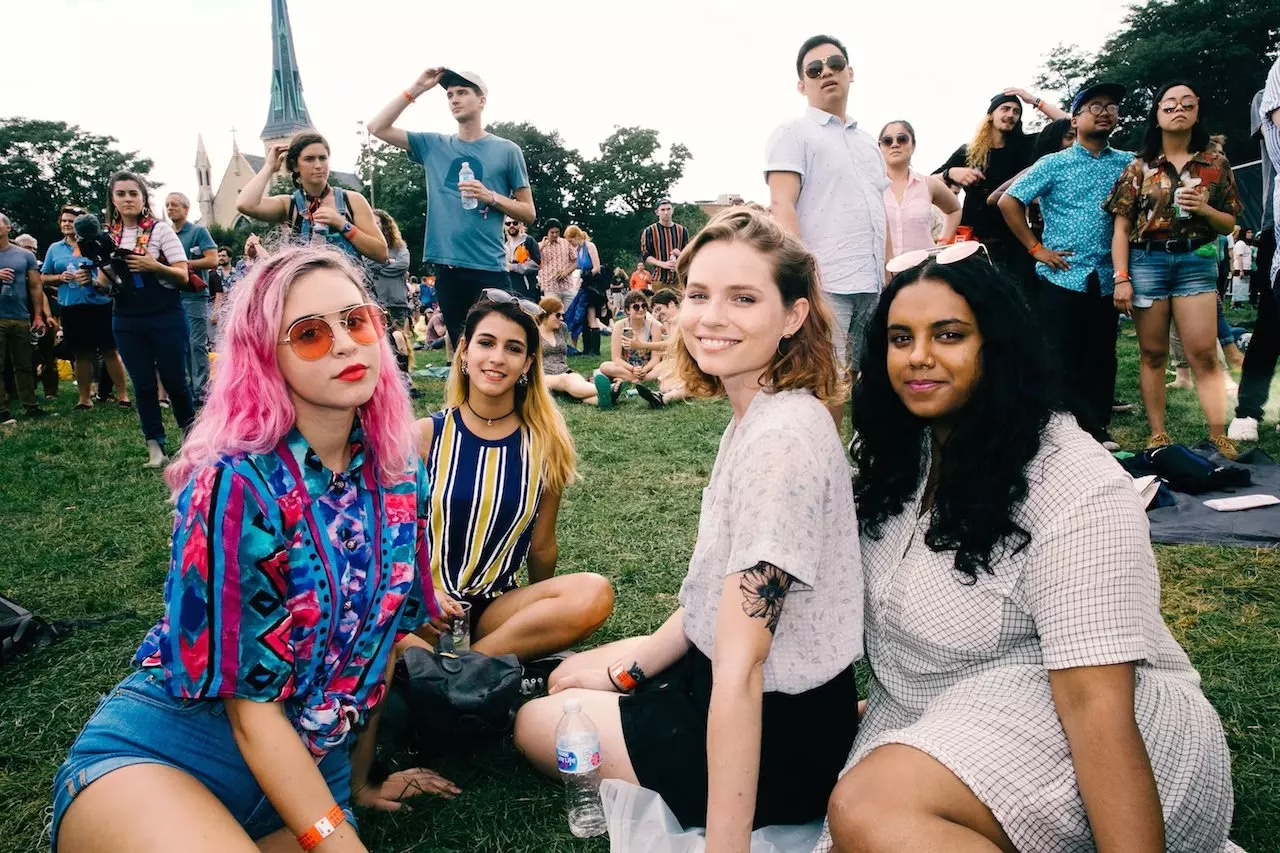
For 14 years, Pitchfork Music Festival has brought a range of new and emerging music to its lineup and while internationally recognized, has kept its festival vibe as Chicagoan as it can—its one of the reasons the fest tries to keep its prices as reasonable as possible.
One of the most known festivals in the city, Pitchfork Fest 2019 will be the place to see the first full North American performance of Belle and Sebastian's If You’re Feeling Sinister and a 60th anniversary perfromance by GRAMMY-winning musical group, the Isley Brothers. Haim, Earl Sweatshirt, Mavis Staples, Rico Nasty, Kurt Vile, Ibeyi and more mae the rest of the lineup.
The Recording Academy spoke with Adam Krefman, Pitchfork Fest's executive director, festivals and activations, about this year's lineup, how it stands out from the rest, festival deiversity and more.
Pitchfork stands out to me, little different. Tell me how you came up with the 2019 lineup.
Well, I think the reason that you see a lot of the same names out there is because there's essentially two companies that own most of the festivals or have a stake in most of the festivals in the country, Pitchfork being an exception to that. So, some of it is by necessity, honestly. We don't have access to some of the acts that you're seeing everywhere. Granted, I tend to think of it as a good thing because then we don't end up with a lineup that looks the same as every other festival out there. We tend to be able to, just in the booking process, be able to figure out what artists are touring where and what other festivals are going to start to look like, so we do try to steer a little bit away from that, if we can.
There's probably 35 considerations when you're booking a lineup and that's a major consideration, but I think our first consideration is really just making sure that we're really reflecting the website and reflecting what Pitchfork is well, as a festival. And then also, we're reflecting what we know people in Chicago or what we think people in Chicago want to see this summer.
I mean, absolutely, you have the Isley Brothers, who are celebrating their 60th. That's pretty dope.
Yeah, you're probably not going to see that on another festival lineup, which is definitely part of what we want to do. And then the other part goes back to the block party roots of the festival, which is you want to appeal to a wide swath of Chicagoans and multiple generations. And [with] the Isley Brothers, it's going to be a great party. Everyone's going to be out there dancing and that is what you want to do on a Saturday night.
Is there an act or experience that you're most excited about, personally?
That's a great question. It's like asking you to pick a favorite child. I've been listening to Parquet Courts' album from last year, Wide Awake, a lot, and my kids are dancing to it a lot and my kids are very young, so it has become like our kitchen dance party soundtrack. So that one I am really, really looking forward to. I think that Neneh Cherry is something that's fairly rare and exciting and is flying under the radar right now, weirdly, because she's been around for long time. And then, Stereolab. We have Stereolab's first show in North America in over a decade, and that's going to be really special.
There's been talks about gender and diversity, I know Pitchfork published the whole report on it. How are you as a festival navigating gender and diversity inclusion?
I guess, we know that it's a priority for our audience, it's certainly a priority for the editorial staff at Pitchfork, and it's a priority for our team, for the festival team. So kind of starting from there, just know that it is priority, it means a lot. It's not like an empty, sort of, "Yeah we'll do that by 2025," or whatever. It's also just not that hard to actually do, at least in terms of the type of booking that we do, which tends to be very open-minded anyways, in terms of it's a fairly large tent, in terms of like genre-inclusive and we tend to be able to book a lot of relatively experimental music that might not work at other festivals. So, I mean, I think your question was: How do we navigate it? If you start from the place of it being a priority, it turns out it's not that difficult to actually do.
I don't know, I guess I can't speak for other festivals, but when we had the opportunity to book HAIM and it's, as far as I know, it's their only show this year, that was a no-brainer. That's like one of the biggest things that we've had a chance to book. And then, Robyn, it was kind of equally a no-brainer. I think, she's just announced Austin City Limits, but, other than that, she isn't at another major U.S. festival, so it was another thing that was like how could we possibly not do that? Especially after she was kind of quiet for seven years and then came out with Honey last year, and our audience just love her, it was a total no-brainer.
So, I don't know, I mean and then you kind of keep going down the line on a lot of our lineup and I can kind of say that about almost anyone. It's not to say that our lineup won't be 40 percent women next year or something like that, but I think that being in the neighborhood of a balanced lineup gender-wise is, it really should be the norm. And I don't know why it isn't. There doesn't seem to be a compelling business reason why it isn't.
Are there any challenges to bringing diversity to Pitchfork's lineup?
It's weird, it's going to sound like glib or something, but I don't think that there are massive challenges to it. I think that there might be some institutional issues with it, where a lot of the bookers and agents are men, and so, maybe there's an unconscious bias thing happening. But, again, I can't really speak to that. We start from a place of knowing that it's a priority for us, we just ... I feel really great about the lineup we booked this year, gender and ethnicity aside, I think it's going to do really well for us, and I think it's going to be a great year. So, I don't know. I don't have a good answer for why there would be industry-wide challenges for it. It doesn't make sense to me.
Do you feel a specific kind of pressure to reflect the diversity of the industry in your lineup because you are attached to a journalistic publication?
Yeah, there's definitely a responsibility to practice what we preach. I'm not on the editorial side and the editors are not booking the lineup, but we're all representing Pitchfork and I fully support and religiously read what the site is doing and they're my coworkers, so as representing that brand, absolutely there is an expectation that we're going to practice what we preach and that we're going to kind of lead that charge.
How important is it for Pitchfork Fest to stay accessible?
I mean, it definitely is. Part of it is there isn't really that much room for more several hundred dollar ticket festivals out there. Pitchfork is still, I think about 70 percent of our attendees are from Chicago, they live in Chicago or the greater Chicago area, so it still is very much supported by what's going on locally here. So staying in line with pricing in Chicago is what's making sure that it's the right value proposition ticket-wise is definitely important. It is getting harder and harder to do so, I understand why other festivals are increasing in price. I mean, costs are really rapidly increasing every year, so it's a really tough place for a lot of festivals to be in.
Bigger festivals tent to have an international appeal, how important is it for you to highlight Chicago culture at your fest?
Well, it is, yeah, definitely important. I mean part of it is just reflecting the community here, the arts and music community here, it's very enterprising. We like to support our own and people are kind of self-made here. And so, that part is just important as the annual celebration of Chicago music and art and culture. For people coming from outside, we have famously terrible winters, mostly during Memorial Day and Labor Day, there are multiple outdoor events every weekend, and for the ... I don't know what 30 percent equates to, probably be, that's almost 20,000 people who travel from outside of Chicago to come for the festival. We do want to give them a taste of Chicago, not literally, because there is a The Taste of Chicago, which is a food festival. That's not what I'm referring to. We would like to give them a weekend of Chicago culture, even if they're spending most of it in Union Park and sort of pulling in the best of what's out there.
The same way, I would say our Paris festival tried to do the same thing with the city of Paris, pulling in some of that stuff from around there, so yeah, I think it's important for any festival to do that. The Chicago festival is really special in that way, just in terms of where it came from, why it was built, and what it kind of remains as, kind of staying true to its core.
