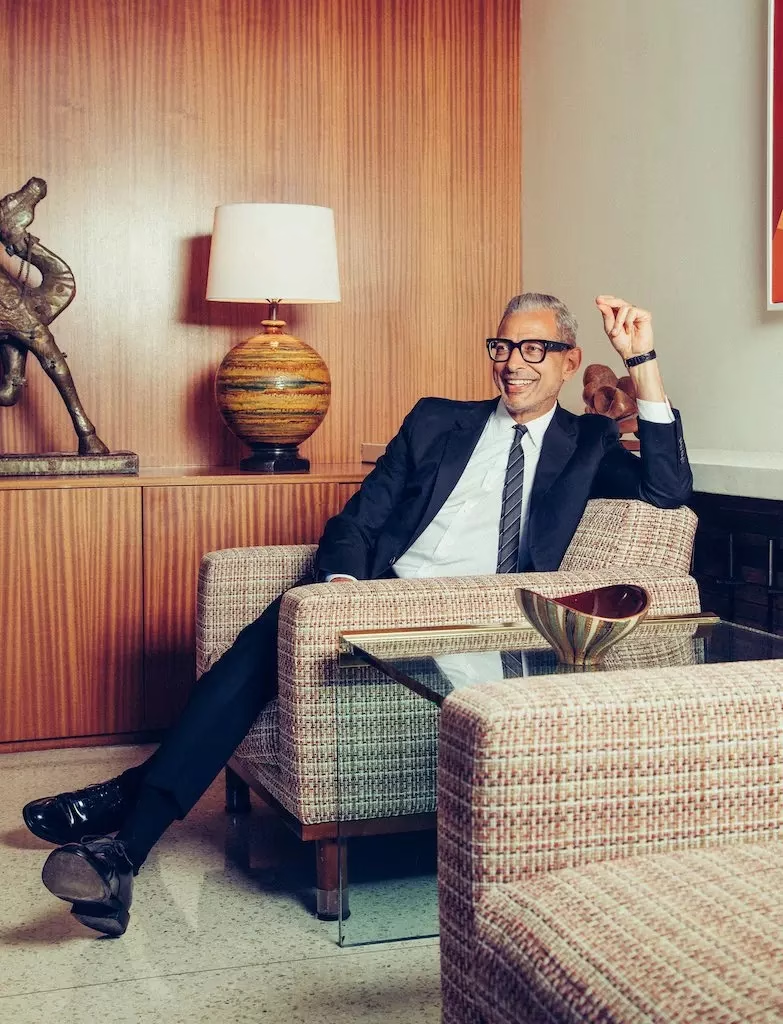
Jeff Goldblum is a lifelong jazz aficionado whose first love was the revered pianist and three-time GRAMMY nominee Erroll Garner, an untaught musician who sat on a phone book to reach his piano keys.
"There's nobody more ebullient in his playing than he is," Goldblum tells the Recording Academy. "Not too fancy. But so joyful in his music," he says about the pianist's 1961 album Erroll Garner Plays Misty, which his father gifted him.
The "Jurassic Park" star was enamored of jazz but pursued acting instead. His career choice paid off: The Academy Award-nominated actor, director and producer can today be found in his own Disney+ series, "The World According to Jeff Goldblum," in addition to regular Hollywood roles.
Still, he never lost the music bug. On Nov. 1, Goldblum released his latest jazz album, I Shouldn't Be Telling You This, featuring his longtime band, the Mildred Snitzer Orchestra.
On the album, Goldblum approaches what can be a stuffy art form with characteristic aplomb, proving that jazz isn’t just for the upper crust or for academics—it's for everyone. Featuring guest vocalists like Sharon Van Etten, Inara George and Fiona Apple on standards like "Let's Face The Music And Dance," "The Sidewinder" (in a medley with Sonny and Cher's "The Beat Goes On") and "Don't Worry 'Bout Me," I Shouldn't Be Telling You This makes jazz accessible.
The Recording Academy spoke with Goldblum about his musical upbringing, his love for Thelonious Monk and Lee Morgan and why playing jazz starts with simply touching an instrument.
<iframe width="620" height="349" src="https://www.youtube.com/embed/p-kRDjv6GNk" frameborder="0" allow="accelerometer; autoplay; encrypted-media; gyroscope; picture-in-picture" allowfullscreen></iframe>
You've been playing jazz while also investigating everyday items like sneakers, ice cream and tattoos on your Disney+ show, "The World According to Jeff Goldblum." Are you trying to understand what makes Americans tick?
I tell you, jazz reminds me of larger issues, and if we do another season [of the TV show], maybe we’ll pick things that are particularly suited for larger ideas about the American story. I've been talking to this fellow named Kurt Anderson, who wrote a book that I like very, very much called "Fantasyland," which has everything to do with the American story.
Of course, jazz is very much part of the American story, and that always interests me. Yes.
Read: Jeff Goldblum's Long Road To His No. 1 Jazz Album, 'The Capitol Studio Sessions'
In what way is it part of the American story for you? What does it conjure in your mind about where we come from?
Well, it's very complicated and exciting, and sometimes it's a story that has many different colors in it, you know? I did this movie last year that Rick Alverson directed called "The Mountain" that reminded me of some of the movies that I liked very much. For instance, Paul Thomas Anderson has done "The Master" and "There Will Be Blood," and I’m a particular fan of Arthur Miller's play "Death Of A Salesman."
So, there are critiques of America that I find very interesting, but here I am in New York City right now, and I'm reminded of that documentary that I saw a couple of times all the way through—several hours—by Ken Burns' brother, Ric Burns, called "New York." It chronicles the American story through the particular lens of the New York story, and there are things that are very hopeful and inspiring and moving about it.
On your new album, you cover "The Sidewinder" by Lee Morgan, an undersung genius of jazz who died at a young age. Why that standard?
Well, I've always loved that song. I know about Lee Morgan; I saw the documentary about him [2016's "I Called Him Morgan"]. That's a tragic story. But I love that song, I love "The Sidewinder," and we wanted to do something that would be a fresh kind of mash-up. The chords go with "The Beat Goes On," and Inara George sings the heck out of it. That song always drives me crazy with delight.
<iframe width="620" height="349" src="https://www.youtube.com/embed/BS4gqtskwec" frameborder="0" allow="accelerometer; autoplay; encrypted-media; gyroscope; picture-in-picture" allowfullscreen></iframe>
Did you appreciate jazz as a kid?
Yeah! I’m from Pittsburgh, and my dad brought home the just-released Erroll Garner Plays Misty album. I was enthralled with it. I took lessons and I was starting to get a little better when the teacher gave me a piece of music arrangement—not yet improvised—but "Alley Cat" and syncopation just did something to me. "Deep Purple," I remember he gave me, and "Stairway To The Stars."
I really sat and practiced until I learned how to play them. And even though I had my heart set on an acting career, I started to call around to jazz clubs that were around Pittsburgh, and at 15, I got a couple of gigs where I was playing. I met a singer or two who would drive me to a couple of gigs. Then I kept it in my apartment in New York when I was 17 or 18 and I was studying with Sandy Meisner. I put it in a couple of movies and plays.
Then, about 30 years ago, I started to play out and about with professional musicians, and that’s how this whole thing evolved.
I like that Erroll Garner was your gateway. His music is unbridled joy.
Oh, yeah. Totally. There's nobody more ebullient in his playing than he is. You know, he was self-taught. Didn’t read music. But what a genius. My dad always commented that he was so short that he sat on a telephone book. He was kind of a working-class type. Not too fancy. But so joyful, like you say, in his music.
My dad really wasn't a musician, he was a doctor. But he would point out the unique thing that [Garner] did: "Listen to how he lets spaces go in between some of his notes." He liked his octaves in what he was doing. He was a big inspiration early on.
Did acting derail your jazz career for a while?
I wouldn’t say it was derailed. In fact, I think now, I don’t know that I'd be getting everyone into these live shows who weren’t otherwise sometimes interested in a movie or two that I’ve done. Even the craft of acting—and I consider myself a humble student of that, as I've sort of developed—has cross-trained well with my musical interests. Listening and improvisation, being present and finding your voice and all that manner of stuff.
But you're certainly right; I certainly wasn't able to play music all day, every day. I like the balance. I like the percentage of both of them.
Does acting teach you to nonverbally communicate with your band?
Yes, I think so! And likewise, I think it works the other way, too. The pure enjoyment I get out of playing music—the nonverbal, like you say, expressiveness—works in many ways in acting. The doors and portals into your heart and strings that are numberless that music can open up can inform acting, I think, too. Yeah.
<iframe width="620" height="349" src="https://www.youtube.com/embed/kD88UV7GMvQ" frameborder="0" allow="accelerometer; autoplay; encrypted-media; gyroscope; picture-in-picture" allowfullscreen></iframe>
Thelonious Monk and Sonny Rollins played with a lot of anger and raucous humor. Do you see great jazz musicians as being like actors?
Oh, sure. I do. Thelonious Monk was not only unique but still kind of inclusive. His composition, "Ugly Beauty," is inclusive of every part of himself and brave and unique and unconventional. I just loved him. And stylish, you know? But I love that [1986] movie "Round Midnight," speaking of actors. Dexter Gordon played so beautifully, and even Herbie Hancock in that movie plays gorgeously, but acted very well, too.
I'm reading the Dexter Gordon biography, Sophisticated Giant. He was such a larger-than-life American figure: jazz's Paul Bunyan. I feel like they don't make them like that anymore.
That's funny that you mention Paul Bunyan. I was talking about him yesterday. One of the things I’m talking about with the NatGeo people [National Geographic developed his Disney+ series, "The World According to Jeff Goldblum"] for next season is maybe incredible figures like that. Yes, those giants of yesteryear, that particular era. Some of which we focus on in our album, '50s, '60s Blue Note kind of stuff. Just irreplaceable.
Jazz is sometimes dragged into academia in 2019. Does it engage your brain, your heart or both?
I think both. I'm in a growth spurt now with these couple of records coming out. I’m trying to do my best. I play every chance I get when I’m on the road. The hotel I’m staying at in New York doesn’t have a piano, but I woke up the last couple of days and walked several blocks to this other hotel that let me play in their little showroom there. I do that very conscientiously every day.
And yeah, it does something to my heart that’s a real tonic. But also, I’m taking lessons and learning from the guys in the band. Joe Bagg is our organist and keyboard player, and I'm taking lessons from him. Alex Frank, who arranged some of these things on the last album, is coaching me in some of my playing and singing, too. I’m really enjoying trying to have some breakthroughs here and there.
Is there still a learning curve to the piano for you?
Oh, yeah. There's so much to learn. No matter what special aspect of it you’re concentrating on, in mathematical ways, there seems to be an infinite amount of possibilities with harmony. It is a real brain exerciser. An exerciser for the whole system. But oh, there’s so much to learn for everybody.
I'm trying to pick up the trumpet lately. It’s slow-going. Any advice for someone who wants to play jazz?
Just do it. There’s a lifetime of listening you can do. I’ve never formally taught piano or any instrument. But when I see my kids—I've got a 2-year-old and a 4-year-old—I think some legitimate and valid early stages are just sitting with the instrument, near the instrument, holding the instrument, touching the instrument, getting a feel for it.
There are so many serious ways you can study. And I’ll bet there are people who want to participate. Start playing together with other people. That'd be fun, too.
Joni Mitchell's 'Mingus' At 40: A Look Back At A Seminal Jazz Collab
