
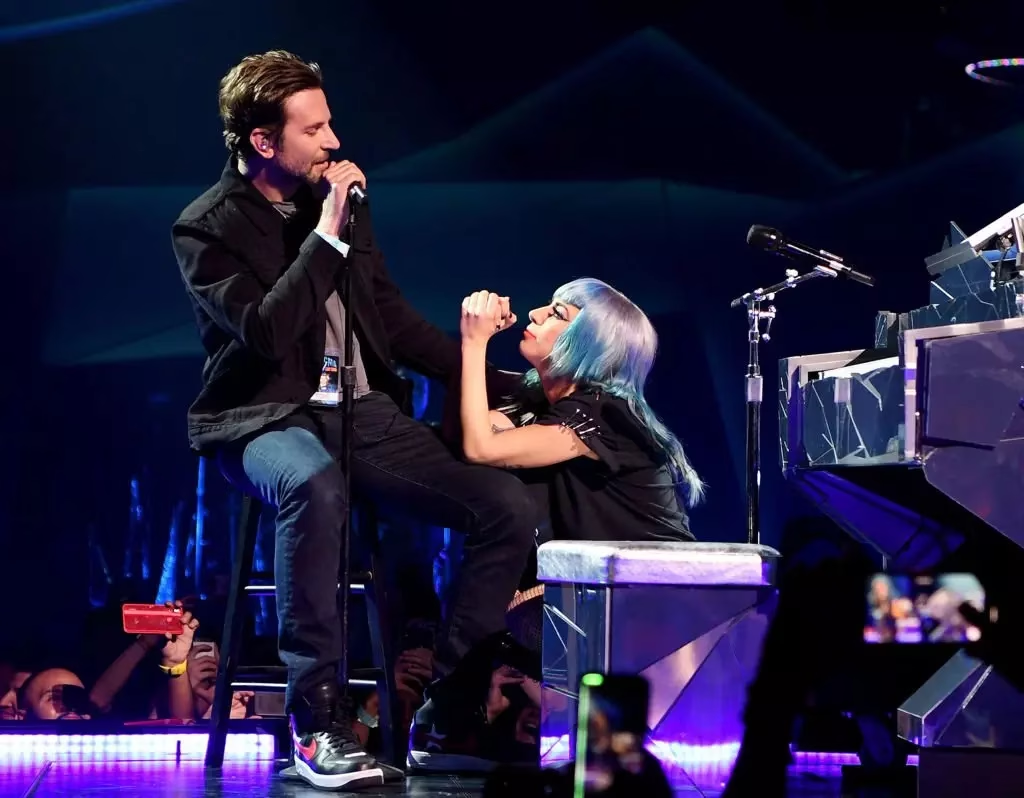
When it comes to the overall trajectory of commerce and entertainment, it's often tempting to read into the theoretical tea leaves that Las Vegas represents. The culture of the Strip itself has, in its own way, reflected the perspective of American culture over time—from its initially seedy-and-glitzy reputation to its rebranding attempt as an adult-ified Disney World that the whole family can still enjoy, to the city epicenter's current residing stance of somewhere in between those two moral poles. A similar transformation has taken place when it comes to the Vegas residency, too: a bespoke entertainment-industry staple that was once the stomping ground of now-musty musical dinosaurs like Elvis and Frank Sinatra has now become part and parcel of the touring circuit for some of the biggest acts in pop music today.
In recent months, Drake and Cardi B announced Vegas residencies off the heels of Lady Gaga's own Sin City spectacular and Mariah Carey's own career-spanning extravaganza from a few years back. This trend is in its early stages, which means that we're likely to see more of music's biggest stars taking a similar route over the next few years; it's not unimaginable to assume that Imagine Dragons—undoubtedly the most successful Vegas-hailing rock band since the Killers—will eventually have their own casino-set stint. The fact that such a prediction could be made for artists nearing the peak of their artistic and commercial success reflects just how far the Vegas residency as an institution—as well as our own perspective of it—has come.
It's commonly held that the concept of a residency itself—in Vegas and elsewhere—was pioneered by Liberace, the singer, pianist, and public-facing bastion of 20th century kitsch who performed on and off on the Vegas circuit from 1944 until the years leading up to his death in 1987. The man born Wladziu Valentino Liberace was such a staple of the Vegas entertainment complex that the city is home to an entire museum honoring the man, situated in one of Michael Jackson's former Vegas properties. (In a full-circle moment of coincidences, future Vegas-residency queen Cardi B's recent performance at this year's GRAMMYs featured Liberace's piano, on loan from the museum itself.)
<iframe width="620" height="349" src="https://www.youtube.com/embed/dioRwB4RvrQ" frameborder="0" allow="accelerometer; autoplay; encrypted-media; gyroscope; picture-in-picture" allowfullscreen></iframe>
Sinatra's regular appearances throughout the 1950s at the since-shuttered Sands Hotel And Casino eventually transformed into "Summit at the Sands," a series of performances that included Sammy Davis Jr., Dean Martin, and Joey Bishop in the hotel's Copa Room performance space—the figurative birth of "The Rat Pack," as it were. Ol' Blue Eyes wasn't the only artist who made an iconographic mark on Vegas around this time; of course, there was Presley, although his initial stint wasn't as successful as his legacy suggests.
Indeed, before his iconic and astounding run at the Hilton Las Vegas, Presley attempted a two-week residency at the New Frontier Hotel and Casino in 1956 that went as poorly as such things could go; the critics were merciless, with a Newsweek critic infamously comparing his presence to "a jug of corn liquor at a champagne party." Later in his career—1969, to be specific—he embarked on the Hilton run, performing a consecutive 837 shows over the course of seven years and thereby outlining in cement the shape of his late career as seen through the eyes of American history.
For all its successes, Presley's Vegas stint also marked his late-period decline—when he transformed from iconoclast to gift-shop trinket in the eyes of the collective American pop-cultural consciousness. And for decades to follow, the mere concept of Vegas residencies was viewed with a similar side-eyed perspective, not unlike a dust-gathering family heirloom too ancient to dispose of completely but not vital enough to pay any attention to.
<iframe width="620" height="349" src="https://www.youtube.com/embed/u4SvBUuB4pk" frameborder="0" allow="accelerometer; autoplay; encrypted-media; gyroscope; picture-in-picture" allowfullscreen></iframe>
In 2013, Chris Bell of The Telegraph referred to the Vegas musical performance circuit's transitional years (decades, really) as "the place where acts went to die." And for a little while the concept of the residency itself seemed close to perishing, as the city's entertainment focus veered away from music and towards big-budget musical stagings of Broadway shows like "The Lion King," as well as the psychedelic, (mostly) all-ages stage shows conceived of by the team behind "Cirque de Soleil."
So, what changed?
Well, for one, financial success. (Is there any factor that drives decisions made in music industry—or any business—as strongly as the potential for profit?) Celine Dion's four-year "A New Day…" residency in 2003 is widely cited as revitalizing the state of the Vegas residency, and at an adjusted gross of over $460 million over that time period, it stands as the most successful residency of all time since ticket-sale data became something people kept track of. "She changed the face of modern Vegas," Caesars Palace Vice President of Entertainment Kurt Melien told The Telegraph in 2013 while discussing Britney Spears' own four-year "Britney: Piece of Me" residency that kicked off that year.
<iframe width="620" height="349" src="https://www.youtube.com/embed/uZlinUueHtk" frameborder="0" allow="accelerometer; autoplay; encrypted-media; gyroscope; picture-in-picture" allowfullscreen></iframe>
Shania Twain and Cher also staged similarly successful stints in between Dion and Spears' own residencies—and Dion's residency also paved the way for the concept of residencies to move far beyond Vegas to other major American cities. Billy Joel has had his own regular spot at Madison Square Garden since 2014, and acts ranging from Prince and Bruce Springsteen to Phish have embraced the concept as well. During much of this decade, the financial boom that came with the music industry's fixation on dance music (EDM, for short) meant that a plethora of DJs—from big-budget guy Calvin Harris to Dutch duo Showtek—were staples on the Vegas strip as well.
As much a financial trend as anything else, as EDM's collective star faded within the music industry its biggest names likewise started to disappear from the marquees of Vegas' hottest spots, and that goes a long way to explain the latest crop of Vegas residencies. In terms of cultural cache, artists like Drake and Cardi carry significantly younger-skewing appeal than more traditional Vegas forebears from this century like Celine Dion, Shania Twain, and (yes, even) Britney Spears; that same appeal coursed through EDM's veins like the sickest bass-drop, so it only makes sense that promoters and artists alike have a vested interest in keeping the Vegas residency circuit from returning to its aged-up tendencies. Most important, it's another newly discovered revenue stream—albeit one lying in plain sight for decades—in an industry that constantly needs to make money but is also constantly finding fewer and fewer ways to do so.
Blink-182, Mariah Carey, Queen + Adam Lambert: Which Vegas Residencey Is Road Trip-Worthy?
