
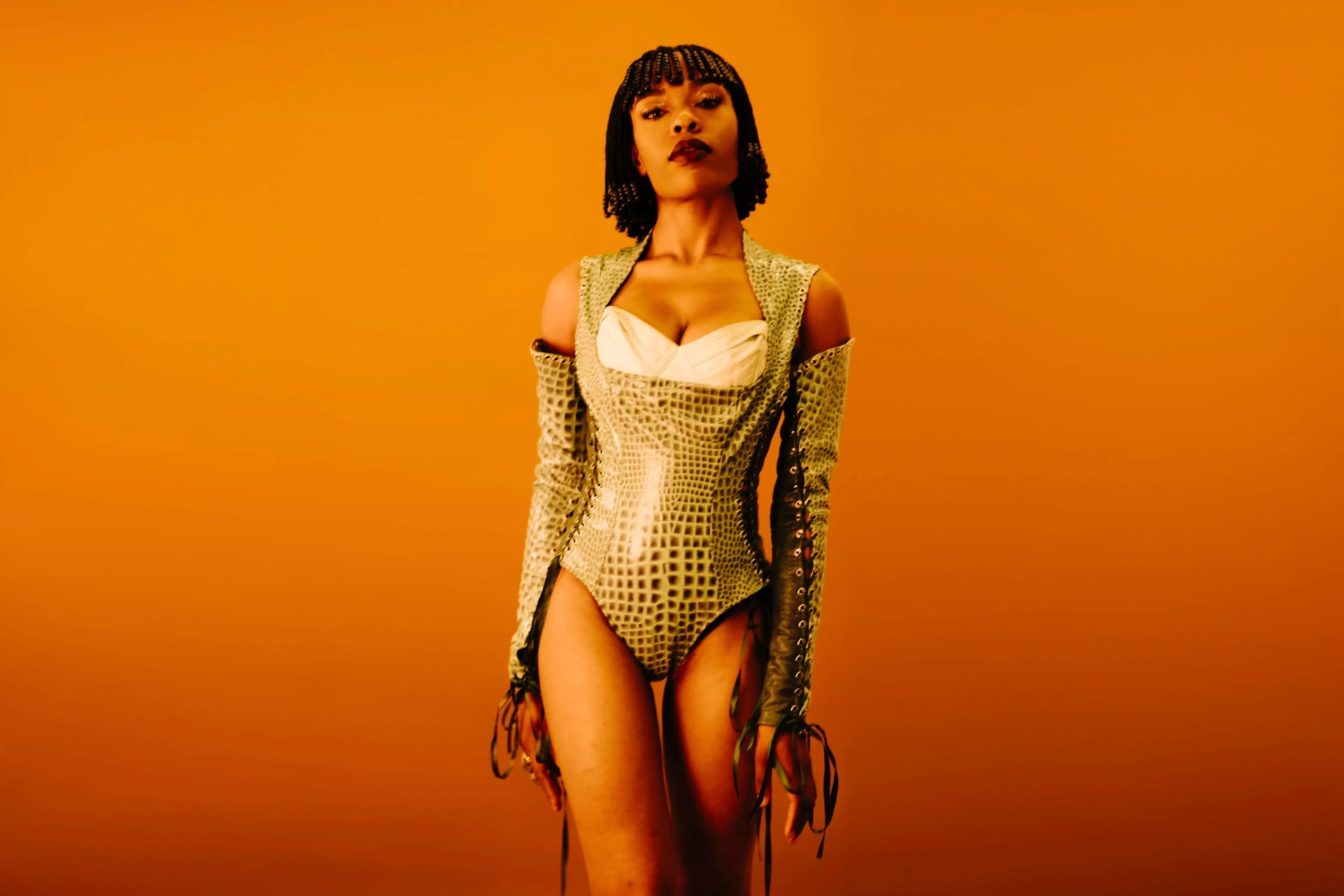
Singer/violinist Brittney Denise Parks, better known as Sudan Archives, is re-imagining the perception of ancient godesses on her debut album, Athena.
"I was looking at a sculpture of Athena, the Greek goddess, and I thought to myself, "Why can’t she look like me?" Parks asks. There's a complexity to the simple question—there are worlds and centuries apart, but when one rises to a place of pure expression, everything else falls away. Parks isn't settling for reflections of whiteness; she wants to see herself. On her album cover she brings her own vision to life; displayed like an ancient European statue, she stands powerfully wearing only her skin and holding a violin high like as if on a silver platter.
"I would see a lot of sculptures while travelling, but I would never see people that look like me," she says."I knew I wanted to make a point about the lack of representation."
<iframe width="620" height="349" src="https://www.youtube.com/embed/BJDMSctOnQY" frameborder="0" allow="accelerometer; autoplay; encrypted-media; gyroscope; picture-in-picture" allowfullscreen></iframe>
The Los Angeles-based artist also reaches back through time with her music, tapping into a deep vein of emotion that ties together myriad traditions and histories. A trained violinist, Parks pays tribute to Sudanese fiddlers and fuses traditional strings with electronic beats, tight R&B harmonies and dozens of other signposts—but somehow the final blend shines with an aura far more than the sum of its parts. Using Greek mythology to make a statement about representation, Athena fits alongside her musical experimentation, interweaving flashes of classical violin and West African string traditions. Athena further mines the mystic depth of her first EPs, expanding the sense of archetype.
From the mesmeric opener "Did You Know?" Parks unfurls a silvery memoir of sorts. The album is full of duality; lyrically, she gives intimate detail, but sometimes they're sketching iridescent clouds. The compositions are intensely evocative, but there’s a constant drive to seek out the new, to explore every corner.
Parks spoke with the Recording Academy about growing her own musical voice out of roots in the church ensemble and an ill-fated pop duo with her twin sister, how her pet snake exemplifies her mysterious persona and learning to lead in the studio to complete her thrilling debut.
The album immediately makes a powerful statement from the cover. You look mighty and powerful, despite being naked and seemingly vulnerable. You're this art object taken in by the viewer, but also commanding and dominating the frame, in control. Tell me about the concept behind the album and how that relates to the concept of the album.
Before the album was done, I knew that I wanted to be a statue. I had a mood board with a lot of statues, specifically these green statues, and they all had the same background. We even decided not to use text on the cover to make it feel like you’re walking past it in a museum. I wanted to have this Baroque feeling. I would see a lot of sculptures while travelling, but I would never see people that look like me. I knew I wanted to make a point about the lack of representation. Also, I was looking at this album cover right now by Francis Bebey. There's this naked lady on the cover, and she's holding a lot of stuff on her head. It has a very similar pose, and I'm just now connecting the two.
Yes, African Electronic Music 1975-1982. She just looks so happy.
Yes, she looks really happy.
I know that Bebey is a big influence on you musically, as well as Ghanaian one-string fiddling. Looking at yourself in that context, as an artwork that can be also judged—were you prepared for that?
A lot of the album has this sense of confrontation and the way I tell stories is a little more upfront. The idea of being a statue and naked and in a museum, it sets up almost that same way.
It made me think of the song on Athena called "Green Eyes", where you sing, "Just feel it, don't fight it." A lot of artists struggle with putting themselves out there while simultaneously keeping a little bit for themselves. Do you feel like this album has allowed you to look at what you've done and really see how you've grown?
Definitely. The EPs before this are bodies of work, but there's something about a first album—it gets more reviews and more critique. You're taken a little more seriously, and maybe even judged a little more.
How have you evolved as a songwriter, singer, and violinist?
I’m not a hermit anymore. I can go into a studio with ideas and build those ideas with other people. Things just never turned out the way I wanted them to. But now my collaborators can help me get there faster because I'm just a better communicator.
From the first trickles of music onto the internet, there seemed to be this mystery embedded in the project, but it never felt like you were intentionally cultivating it. In fact, your voice is so open and emotionally present. What do you think creates that feeling of enigma?
People think that about me in real life, not even just listening to my music. I really am trying to figure out what makes me seem mysterious. I have this pet snake and he's kind of mysterious. I think he's just like that because of his personality. He's really just shy. That might have something to do with why people think I'm mysterious. Maybe it's just my nature. I'm kind of reserved naturally.
As a child, you and your twin sister were working for a time towards a pop duo, guided by your father—but that also you would miss rehearsals and the like. Did you immediately see music an exploration of your own identity?
Yeah, but I had to fall in love with it in my own way. The way that my step dad thought it should be sounded crazy to me because he had a really high expectation and a certain type of musician that he wanted us to be. He used to work with musicians like Babyface back in the day, so he just had a certain way to make things happen. He would say things like, "Yeah, you guys are gonna be as big as Justin Bieber." And when he'd say stuff like that to me, I would be like, "That's not true. Why are you lying?" I didn’t want to be as big as Justin Bieber. I just don't see my career being that big. I saw my career being something that's more of a hobby even. I just didn't like all the pressure at the time. I don't think I knew what I wanted to do yet, but I knew what I didn't like. So just imagine someone trying to help you and putting all this effort in, but you're being hard to work with, you're being rebellious and ungrateful. I had to fall in love with music in my own way. Sometimes I would pretend that I was working at McDonald's on night shift just so I could be out later, past curfew. But I would actually go out to electronic shows, multi-instrumentalist producers and artists. And that's where I started learning about the electronic music scene.
The album opens with pizzicato picking and what could be a statement of strength, but has this past tense twist: "When I was a little girl, I thought I could rule the world." That realization that life wasn't perfect. How did you get the confidence to find out what you wanted to do?
I was always playing violin in the church choir. That gave me a lot of confidence and the skill to play by ear. Once you figure out how to play by ear, you can do anything because you can just pick up any instrument. It may take you hours, but you basically can figure out the exact pattern and notes that you want. So I started to just mess around with iPad apps, GarageBand and stuff, where you're able to record your voice and the violin and add drums and piano. Being able to do that all on my own, it made me feel like that's the route I wanted to take.
What has been the biggest shift in your process for this album?
I wanted to work with other people and to have a clear theme, like the rap albums that I listened to when I was younger. I remember listening to lots of Outkast and Kanye West, and they always had strong themes and interludes that would weave in and out of the album. I just knew that I wanted my album to have that kind of theatrics.
You worked with a rather interesting trio of producers: Washed Out, Paul White, Rodaidh McDonald. While they're not from completely different worlds, each has their own style. How did you so successfully bring these disparate ideas together?
Some people already had a production beat and then on top of that I added more production, more of my style, more violin. And then some of the tracks we started together, putting the idea together from scratch. Some ideas were demos that were already simmering for a long time but just needed lyrics. I worked on storytelling with this writer, James McCall. It was cool to write with someone like that, someone who has a history with the LA beat scene. In San Diego, this producer, Andre Elias, he wrote "Green Eyes" with me. That got revamped probably 10 times. I sent this one idea to Los Retros, this young artist on Stones Throw, and he revamped it and made it sound more jazzier—and that became the interlude and outro of "Limitless". He gave it this old soul feel, this Erykah Badu feel.
RELATED: Ari Lennox On Representing Dark-Skinned Black Women, Why She Loves Roots Picnic & More
The album is so driven on duality. When did you first really feel that complexity?
When I was listening back to songs, some of them started to feel like younger versions of me. Some of them really were, because they were demos that I decided to actually finish. For example, "Pelicans in the Summer," the verses come from a demo that was made years ago, but then the hook is a new addition to that. I made the song “Did You Know” when I was 15 or 16. Since the album is supposed to be like a biography, it probably should start at that time.
I was trying to figure out why they sound so different from each other, and that's when it clicked that the album is driven by duality. Maybe it's a battle between a younger version of me and a more mature version of me, confronting issues between.
"Glorious" is a standout track towards the end of the album, which would make it closer to today biographically. It’s a great example of seamlessly fusing a simple but affecting string pattern with a tight beat and harmonies, almost distilling your aesthetic into bite-sized chunk.
I made that song with Wilma Archer and James McCall. It it was a last-minute session, since James lives in London and he was in town. And I think that's toward the end of the album because it was made most recently and after all of the conflict, it's a reminder to just focus on your family and your loved ones.
We talked about Francis Bebey earlier and getting inspiration from African artists. What did those artists unlock in your story?
One of the issues I'm talking about on the album is colorism and how sometimes you're judged by just the color of your skin. Those artists inspired me so much because growing up I was always the only black violinist at school or in a music program. I felt like a black sheep. When I discovered all of the African artists and people around the world playing the violin in their own way—it just does something to you when you're little and you see people that look more like you. Erykah Badu, Brandy, dark-skinned beautiful black women—they did a lot for me too, even though they weren't violin players. People that look like you when you're younger is really needed because it pushes you to keep doing what you're doing.
It doesn't really make sense not to have meaning for your work. That's probably why I didn't want to do the pop duo thing: it didn't have meaning. But once I found meaning and purpose, I was able to go in and focus.
What were the things that really surprised you about this album and going through the process of an autobiographical story about your life?
I learned that it's okay to just embrace all the sides of you. Sometimes things aren't really going to make sense at a certain time, but it doesn't mean you're going the wrong way. You might just have to go through some times that don't make sense at all until you get to the finish line.
