
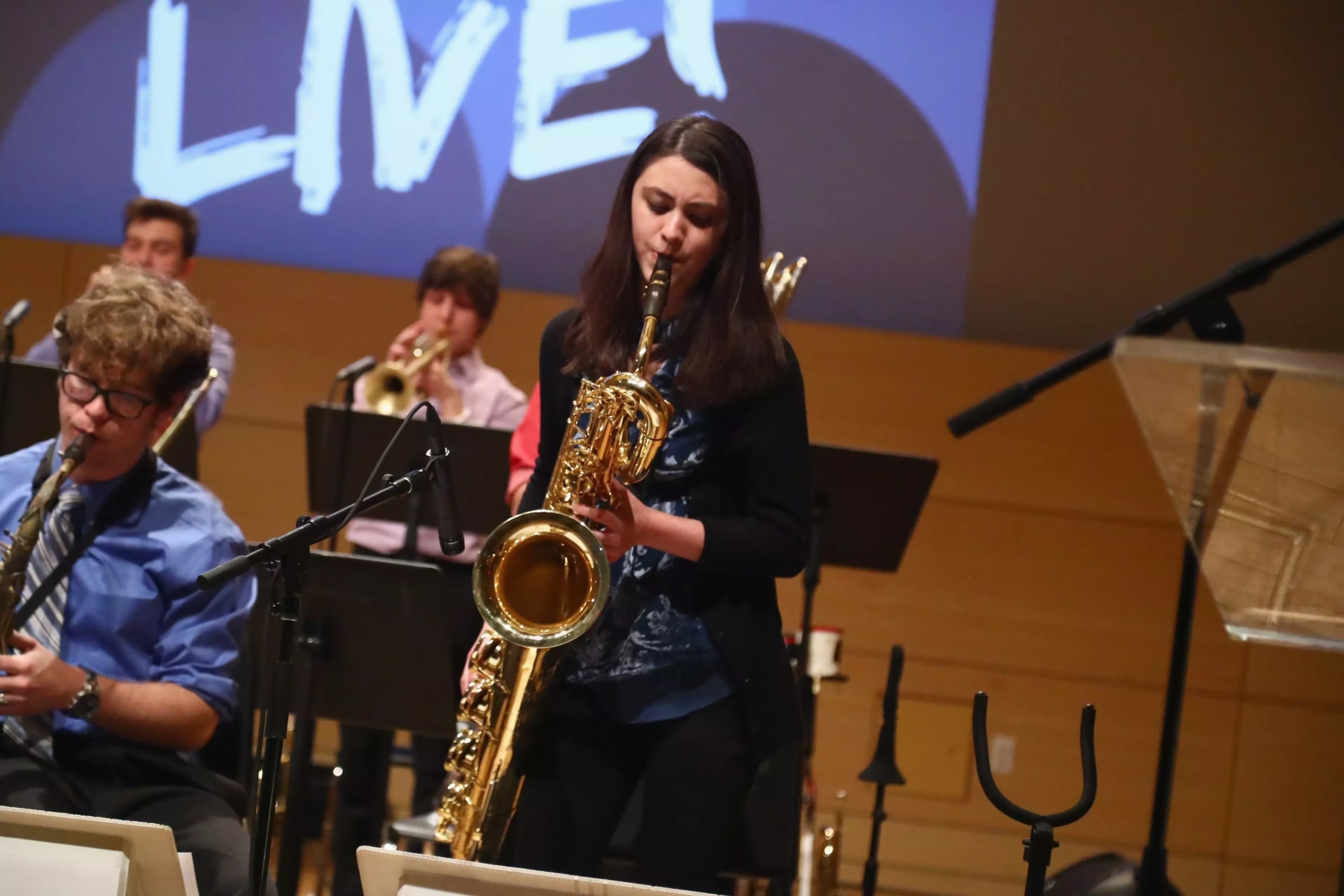
After spending the first few days of GRAMMY Week getting acquainted, rehearsing and plotting their schedule, the members of GRAMMY Camp — Jazz Session finally got to let the music do the talking at the GRAMMY In The Schools Live! concert in New York City on Jan. 25.
Taking place at The New School's John L. Tishman Auditorium, the GRAMMY Museum event proved to not only showcase this year's class of Jazz Session students and the many alumni of the program who were in attendance, but it also spotlighted the year-round initiatives of the Museum, which include a range of programs for youth musicians and music education.
The event also acknowledged the Recording Academy and GRAMMY Museum's 2018 Music Educator Award recipient Melissa Salguero, a music teacher at P.S. 48 in the South Bronx.
"This is one of the most epic moments of my life. My dream was to teach in a city that loved and cherished music," said Salguero. "To be honored in New York City as a New York teacher, this has been one of the most amazing experiences in my life."
But on this January evening, the spotlight shone brightly on the 18 young musicians in the Jazz Session band — comprising five saxophones, five trumpets, four trombones, bass, drums, guitar, and piano.
With direction from conductor Justin DiCioccio, the band performed a taught set list showcasing, in DiCioccio's words, the "different styles and moods of jazz." Out of the gate, the band swung through Neal Hefti's "Whirly Bird" with a brisk fervor, highlighted by the sax chairs trading solos.
They segued into "Cabeza De Carne," a Latin clave-based tune that put some pep in the audience's collective step, and Benny Golson's "Along Came Betty," which seemed to bottle the sounds one might hear at 2 a.m. at a late-night NYC jazz club.
"We've had one rehearsal, by the way," quipped DiCioccio in between songs.
Following a take on Randy Brecker's "Sponge," which featured cool riffing and angular walking bass lines courtesy of guitarist Jordan Reifkind and bassist Augustus "Gus" Allen, respectively, the Jazz Session members kicked into high gear.
The ensemble performed a spirited take of Buddy Rich's "West Side Story Suite." The multi-layered composition was chosen in honor of the centennials of composer Leonard Bernstein and famed drummer Rich. Appropriately, the sprawling tune was sparked by brassy punctuations and impressive stick work by drummer Varun Das.
Next, the musicians' showcased depth and range that belied their experience on "Red Hair, No Freckles," a complex piece composed by GRAMMY Museum Executive Education Director David Sears, who offered, "If we play it right, your body should move." Judging by the audience reaction, they indeed got it right. The collective navigated the multiple odd time signatures in the piece with aplomb while interpreting the tune's R&B, funk and progressive pop flavors that ably mixed elements of Earth, Wind & Fire, James Brown and Chicago.
For a special encore, the Jazz Session band was joined by one of their own, alumni Jon Batiste. The gregarious pianist/bandleader for "The Late Show With Stephen Colbert" — who came straight from a show taping to play with the students — sat in for a performance of Duke Ellington's "Kiki" and Count Basie's "Splanky."
In the presence of the senior musician, the band upped their game and matched Batiste's fire, measure by measure. For his part, the smiling Batiste dazzled the ivories, with his playing light as a feather and forceful at the appropriate moments and improvised solos that were ripe with articulate calls and responses, motifs and linear flourishes. Jazz Session pianist Esteban Castro, who stepped aside for the final two songs, smiled for the duration as he witnessed the masterclass.
As for the Jazz Session members, the experience and education they amass during their GRAMMY Week crash course will certainly bode well for their future careers. And the time they are spending together in the Big Apple constitutes a form of networking, which one alumnus described as an integral part of the GRAMMY Camp — Jazz Session experience.
"[I advise them to] keep in touch with each other," said David Grossman, a pianist/bassist who was a Jazz Session band member in the mid-'90s. "They might know this but their fellow bandmates, hopefully, they'll know [each other] for a long, long time."
"These are some of the finest young jazz players in the country and we are giving them a very unique lens of what it means to work in music," said Scott Goldman, Executive Director of the GRAMMY Museum. "The kind of challenges that they will face as a working musician, the kind of discipline that is required by a working musician — this is an experience that I don't think you are going to get in any conservatory setting."
