
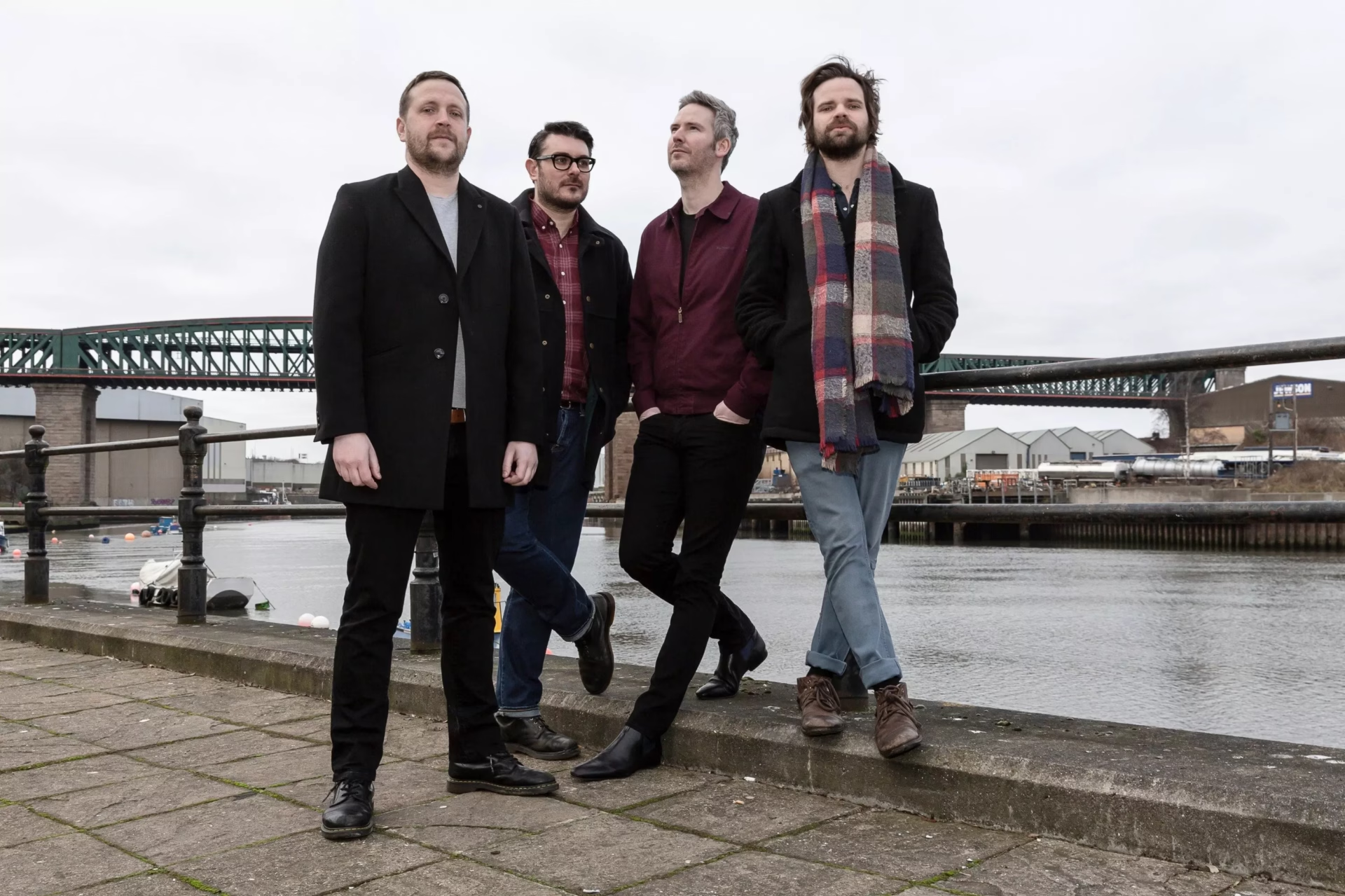
When The Futureheads disbanded in 2013, one year after their fifth studio album, Rant, came out, they didn't make a big deal out of it. There was no announcement, no reunion tours. They, as some meme-loving folks would say, "Homer Simpson'd into the bush."
According to singer Barry Hyde, who initiated the split, the rest of the U.K. post-punk quartet were very understanding. They had to be: Hyde had just finished his third stint in a psychiatric hospital. He physically could not contend with being in a band anymore. "I just simply couldn't do it," he tells the Recording Academy over the phone. "I wasn't capable of creating for The Futureheads, with The Futureheads, and doing the gigs and stuff like that. It became very taxing for me."
In the six years since their split, Hyde made it his first priority to get healthy and figure out what his professional life could look like outside of music. He trained as a chef, then became a music teacher. He got his MA and released a solo record called Malody. He does public speaking engagements where he talks about mental health awareness. The rest of the band, who had been playing together since they were teenagers, also found new lives outside of The Futureheads, which blew up in the early '00s with their landmark self-titled debut featuring a series of twitchy, "paranoid-rock" anthems like "Decent Days And Nights," "Meantime" and a now-classic cover of Kate Bush's "Hounds Of Love." Bassist Jaff Craig also went into teaching. Brother Dave Hyde (drums) went on to release two albums as one half of Hyde & Beast and trained as a tiler. Guitarist/vocalist Ross Millard joined the band Frankie & the Heartstrings. Now, the crew has joyfully reunited for their sixth album, Powers, which arrives on Aug. 30 via Nul Records.
Futureheads fans will be pleased to hear that the group has barely deviated from their trademark layered harmonies and fidgety guitar-work. Powers is a propulsive look at the personal and political. Songs like "Electric Shock" and "Headcase" plainly deal with Hyde's psychiatric history ("When I got my electric shock, it tasted bittersweet," he chants). Other tracks, like "Across The Border" and "Listen, Little Man!" consider the xenophobic rhetoric, regressive thinking and power imbalences in the U.K.
Prior to unleashing Powers, Hyde called up the Recording Academy to discuss The Futureheads' reunion, his new role as a teacher and public speaker, the subtle cultural differences in how Americans and British cope with mental-health issues and more.
<iframe width="620" height="349" src="https://www.youtube.com/embed/5VN8fkUzGUM" frameborder="0" allow="accelerometer; autoplay; encrypted-media; gyroscope; picture-in-picture" allowfullscreen></iframe>
Before we talk about the new record, I'd like to talk about the day you decided to discontinue the band. Would you say that it came as a surprise to the rest of the members? Or would you say that this was something that was kind of roiling openly for a little while?
Well, I think the fact that I was in a psychiatric hospital for the third time, having been in and out a couple of times, it wasn't so much a surprise. I think that Jaff [Craig], our bass player, was probably pleased that he didn't have to think about the band anymore. And I think it was a bit harder for Dave [Hyde] and Ross [Millard], because I think they always felt like there was a chance that the band could continue. But I just simply couldn't do it. I wasn't capable of creating for The Futureheads, with The Futureheads, and doing the gigs and stuff like that. It became very taxing for me. And it seems almost absurd that it got that way. Because, ultimately, it's just a band, at the end of the day.
After a certain point, I realized I had to clear that part of my life in order to stand a chance of not having to come back in the hospital in six months. So they were very supportive of that decision. And it was a hard decision to make. But it was an instant thing. As soon as we had this discussion, there appeared for me a space, a gap in my life which I could grow in, if you know what I'm saying. And it was a kind of unfortunate release, you might say.
Yeah, from a fan perspective it never seemed clear why The Futureheads weren’t around anymore. There was no announcement or news around the split.
Yeah, we didn't do like a farewell tour. We never announced that we'd split up or even that we're having a break. Yeah, the candle just kind of died. And we had no idea, actually, for quite a lot of that time, that six or seven years, that it was ever going to [reemerge]. It wasn't like we stopped working together for like 10 or 15, 20 years. We have made very different proposals to kind of get back together. But it did happen in an organic way. And as much as I was able to regain my creativity back, make my solo album. And then, yeah, called Malody. Which was almost like a chronicle of some of the things I'd been going through.
Because really what matters is that you want to pick up your instrument. You want to play the guitar. You actually want to enjoy the simple act of practicing your skills. And I went into the world of piano, and teaching, and orchestration, and all of that stuff in the meantime between stopping the band and getting it back together. And that was enough of an escape for me to be able to start to fondly remember this band that we created very innocently at the very beginning of the 21st century.
<iframe width="620" height="349" src="https://www.youtube.com/embed/TIwAgSug09Y" frameborder="0" allow="accelerometer; autoplay; encrypted-media; gyroscope; picture-in-picture" allowfullscreen></iframe>
Given your backstory, to what extent are you comfortable talking about what you’ve gone through, mental-health-wise?
Yeah, I would say I'm comfortable enough to have spent time traveling around the United Kingdom giving talks on it. I've become somewhat of a, well, I would say minor, spokesperson for mental health and creativity. And I was able to use that experience as a way of sorting my own head out and I think, in some cases, opening up the discussion for other people as well. Because it is still a major taboo. And I think that's one of the differences, actually, between your country and my country. Is that in America, I think, people are a lot more open, perhaps, to talk about their emotions. Whereas the Britishness is kind of like get on with it. It's a cliché. But the kind of stiff upper lip. We beat the Nazis, so why do we need to talk about you? It still lingers on, especially in men. And I know there's lots of macho men who are incapable of expressing their emotions in America, as well, and all over the world I guess.
Yeah, so I'd say I was fairly unique. And also, in releasing Malody, that was the context of the album. So it'd given me the opportunity to perform in those songs. It's my opportunity to kind of relive those emotions. And I wanted to sound trite, leave them on the stage. And it's kind of like a publicly funded CBT session.
I’ve spoken to musicians for this site before about how the negative stigma around seeking mental healthcare is changing, thanks in part to the Internet and social media. To what extent have you seen positive change around this, even in Britain?
Yeah, we are kind of getting better at it. I feel like few extremely high-profile people, much higher profile than I am, for example, Prince Harry, talking about how he felt after his mother died, Princess Diana. And there was definitely a moment, or a period in time, when it became a lot more accessible to discuss these things.
But the truth is, when you're that way, you really don't want to talk about it. It's usually after the fact. And that's the hardest thing. Because you don't want to become that person who, when someone says, "How are you doing?," then you give them a massive diatribe on your inner psyche. Because, ultimately, it is inner. And sometimes, you can end up exacerbating the problem by focusing on it. So it's kind of a bit of a risk to then be seen as this person who has these problems. Because it does affect how people see you and treat you. And I certainly experienced that when I had kind of been in and out of hospital. And news got around town, because it's a small town. And certain people were very keen to try to help me. Or some people would stay well away, as if it was some kind of contagious thing. And I don't blame them. Because they, obviously, are not able to discuss their own inner world. And I respect that.
What made you want to actually go and speak publicly about your experience?
Well, I like to talk. I'm a teacher. I'm a peacock. I was a very shy child, actually. And through being a performer, I learned how to communicate on the front line in front of increasingly large crowds. And that's going to have an effect on you, and not all those effects are positive. But one of them is knowing how to get your point across. And knowing how to choose your words. So you're not just a rambler. You can be selective about what you say. And, perhaps, say the right thing at the right time. And that's a very powerful thing.
It sounds like there's a sort of a connective tissue between Barry the speaker and Barry the performer. Someone who knows how to conduct himself in front of a lot of people.
One of the dangers of becoming a performer is that it's very easy to stop practicing the generation of self-esteem. Self-esteem is so important. That's what allows you to walk down the street confidently and know what you're doing. And when you're getting rounds of applause, you can become intoxicated by it. And you lose those functional skills of how to actually define yourself without that crowd, without those reviews, without the interviews, without the privilege. And then, if you find yourself on a downturn in the music industry, which happens to everyone. People think about the Rolling Stones. The Rolling Stones haven't made any true contribution to music since probably the early ‘70s, but they're still carrying on, doing their thing. Right? But people say, "Well, they should stop." It's like how dare anyone tell a performer that they should not perform. It becomes part of your DNA. It becomes why you exist.
<iframe width="620" height="349" src="https://www.youtube.com/embed/E0RcsVnkWWc" frameborder="0" allow="accelerometer; autoplay; encrypted-media; gyroscope; picture-in-picture" allowfullscreen></iframe>
So when you guys actually decided to head back into the studio and record again, had much changed in terms of the band's chemistry?
It was a case of remembering than discovery. It was remembering how to be in the creative unit with these people that you've made lots of records with.
The hardest challenge, actually, was scheduling enough time. And we realized this when we started to rehearse. It was like, okay, we've been able to rehearse once a week, and then, maybe, the next week we couldn't. So we just thought, you know what? We just best start going whenever we can get together. We should be in the studio rather than a rehearsal room. Because at least, then, we'll have some kind of artifact, hopefully, at the end of the day to build upon. So it was very drawn out. Because we're used to hiring a studio for two, three weeks and making an album. This took maybe 30 sessions over the course of about six months. So the challenge was getting together into a room and whipping up that creative spirit on the dot. Like whisking an egg. Because you don't want to waste a day in the studio.
Yeah, it sounded like you guys started the process like a year ago, almost.
We did. I spoke to Ross on the phone two winters ago. We said, we're going to get together and do some stuff. And Jaff was like, "I'll only do it if we make a new album." And then, actually, we realized we couldn't really start it for another seven months. And that gave us time to get material together. Well, the writers in the band, predominantly myself and Ross. We're able to kind of scratch away at- Well, it's rock music. So, basically, riffs. Guitar riffs. And loving that. I've got three children now. And I work as a lecturer, and do commissioned work in private tuition. It was a juggling act for all of us in different ways.
Well, we got there. I'm really proud, actually, of this album. Because I know what it took to make it in terms of commitment and beliefs. Because, you know what, your album doesn't sound very good until it's mixed. And that happens at the end. And you've got to hold onto that confidence and regenerate it every time you go in. To know, actually, you're going in some kind of correct or authentic direction.
<iframe width="620" height="349" src="https://www.youtube.com/embed/fcMAM9B7yAA" frameborder="0" allow="accelerometer; autoplay; encrypted-media; gyroscope; picture-in-picture" allowfullscreen></iframe>
Moving into Powers’ track list, you guys also delve into the very relevant issue of changing British politics. Which tracks do you feel best illustrate that conversation?
I can only speak to my own songs, really. When I say my own songs, I mean the songs that I've brought. Obviously, these are our songs. I was the principal writer on this song called "Listen, Little Man!," which is about the kind of imbalance of power in society whereby the general population are placated into being and doing by the pressures of the world. And, meanwhile, there are a group of people who are just watching it all and manipulating it. Without wanting to sound like a paranoid conspiracy theorist or whatever. But it's true. We have the political class who are, in my opinion, absolutely embarrassing, right now, in this country. Self-obsessed careerist people with no social wisdom at all who've, generally, come from immense privilege and wouldn't know what it's like to make toast. And never mind balance a household. Then, come with no inheritance. Then, come with no privilege. Everyone else. You're talking about a very small amount of people with that privilege. They are kind of playing the tune.
And I don't want to sound cynical, because I think our duty as people is to find meaning in our lives regardless of the political situation or regardless of when we're born into history. That's always been the same. And we find meaning, often, to making things happen despite the odds. And that's where we gain our power. The album is called Powers also because this is an example of us using all of our powers. All of our musical power. All of our powers of friendship. Powers of commitment. Powers of schedule. And carrying it through to the end. When the album's out, then, we'll be able to be truly proud.
