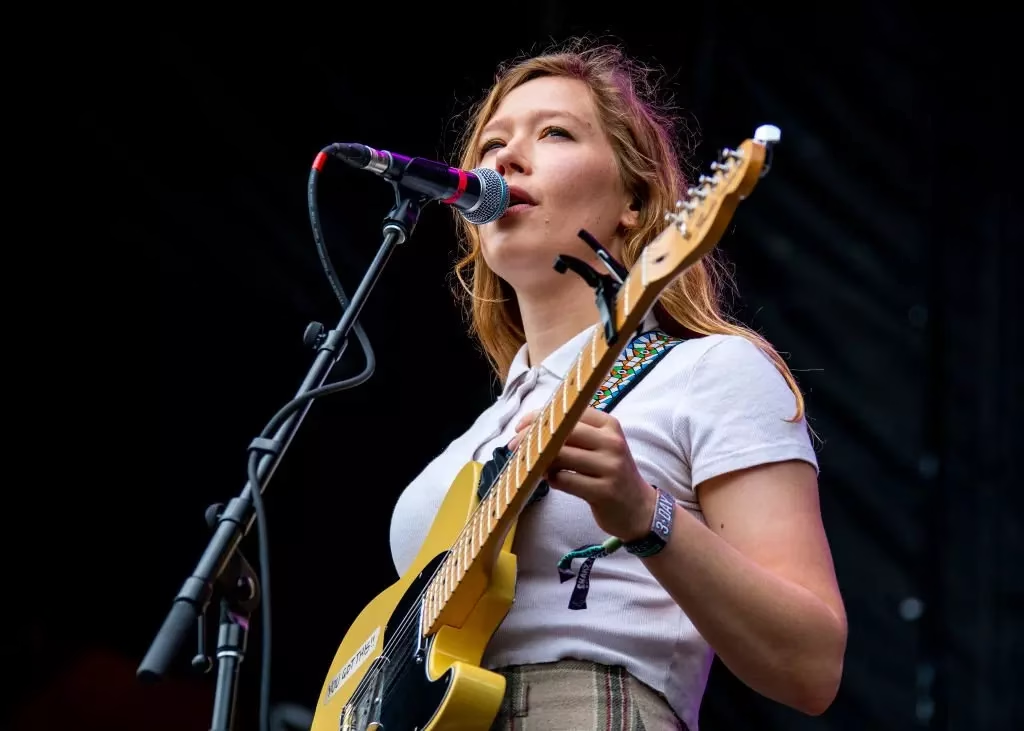
Australian singer/songwriter Julia Jacklin's voice alone could capture a room. Her two albums, Don't Let The Kids Win and Crushing, showcase a vulnerable set of folk-pop songs that are equal parts energetic and melancholy.
In Crushing, her sophomore album, Jacklin creates a body of work about relationships, romance and breakups that reflects one of the greatest things failed partnerships can give us: a sense of self. In "You Were Right," she's come out the other side stronger, proclaiming: "Started listening to your favourite band/ The night I stopped listening to you./ You were always trying to force my hand/ But now I'm listening because I want to ... You were right, I liked it/ You were wrong, I was a good friend."
<iframe width="620" height="349" src="https://www.youtube.com/embed/XXnw6gYX_IA" frameborder="0" allow="accelerometer; autoplay; encrypted-media; gyroscope; picture-in-picture" allowfullscreen></iframe>
Though sophomore albums can make or break an artist, Jacklin shows her best work yet. Despite the rave reviews, her own approval is what really matters to her.
"I'm proud that I've made an album that I really like because I think that's very hard to do," she tells the Recording Academy. "You know, I think as artists we overthink things and we're our harshest critics and it's really easy to make something that resonates with other people, but you yourself don't."
Jacklin spoke to the Recording Academy after her set at Austin City Limits 2019 about the experiences behind the songs on Crushing, the aspects of being a rising musician that some may not understand, her creative process and more.
What do you like about festivals so far?
The catering's really good. The acts are really good. Lot of women playing, which is great. Yeah, it's a good festival.
Crushing is a very honest album and you cover a lot of personal things. What mindset were you in writing the songs?
Yeah, I don't know. Just, it's pretty evident I think if you listen to the record where I was at.
"Head Alone" stands out to me. It sounds like it's about about learning to place physical boundaries. Is that accurate?
I guess that song is kind of more about interactions that you have even with friends and with fans. I think being a musician you're constantly in very small spaces with lots of people. I guess if people think that you're for the taking as an artist, then they also feel a bit like they can touch you a lot.
But, no, for me that song was more about just like feeling very suffocated and just feeling like of in every aspect of my life like the walls were closing in a little bit.
I think that's a very interesting perspective because I know that Justin Bieber at some point stopped doing fan meet and greets because it was just getting to be a lot for him and he needed to focus on his mental health. I don't think fans and people in general really understand what it's like to come in contact with so many people every day.
Yeah. [They] tell you very heavy things. I mean I'm obviously not as famous as Justin Bieber, but I think [it happens] at every level if someone connects with your music. I've done this when I was younger as well, where you feel like you know the person very well, so if you do come in contact with them you already have this relationship with them and probably feel a bit more comfortable to physically kind of touch them or you know. But the artist doesn't know who you are.
But that song is not about that, really. It was just more just about how in tiny interactions I had with men in my life, just feeling like I was being treated differently than my male counterparts.
What are you most proud of in regards to the album?
Probably just that I'm proud that I've made an album that I really like because I think that's very hard to do. I think as artists we overthink things and we're our harshest critics and it's really easy to make something that resonates with other people but you yourself don't. After a while, you feel self-conscious about it or you just wish you'd changed it or done things differently. It helps to tour the world and be away from friends and family and any stability in honor of a record at least I really like. If I didn't like it I'd be like, "Ooh, is this worth it?"
Do you feel pressure at all to write radio hits?
I feel a tiny bit of pressure for that, but not really. I'm like a low-key singer focusing as a songwriter. I write all the songs myself. I'm not really searching for big pop stardom. So it doesn't really apply to my world, I think. But I can see that a lot of other people feel that pressure and get a lot of flack from their labels and their managers and stuff to try and make things more radio-friendly. But not me.
How do you create music? Do you come up with a melody first, or you write the song?
It's different every single time. I think every artist who gets asked that question, which we all do, it's just like there's no good answer. Sometimes it can be the words first. Sometimes it's the melody. I think if I had a method it would be a lot less stressful. But usually you're kind of waiting for inspiration to strike you.
In your opinion, what makes a good song?
I don't know. It's always so different, isn't it? I think if the artist is being authentic and that doesn't mean that they have to be telling the truth in their songs, it just means that they're coming from a place of integrity and they are fully backing what they're doing. I think any form or structure of a song can be incredible. As long as the artist is not pandering to current trends or trying to please other people. I think the best songs are always just ones that the artists needed to make for themselves. And then it's just a bonus that it resonates with other people.
There are a lot of high-profile female artists collaborating with each other lately, like the Highwomen, and even starting music fests featuring an all-female lineups, like Lykke Li's YOLA Día. What do you think about that movement?
I don't see it as a movement at all. I just see it as the world the way that it's going. You know, I think that it was just inevitable that women realize that they are locked out of these structures and that after hearing so many times like, "Oh, sorry you can't headline this festival because you're not going to sell enough tickets." Which is just ridiculous. They were just like, "No, screw this. [We're] going to start our own festivals then."
Yeah, I think every woman is sick of hearing about why there aren't more women headlining festivals when right now women are killing the game. Which is great about ACL because there's been some great female headliners to this festival. I've been doing three months of festivals and it's pretty rare.
I think a lot of my friends and other female singer-songwriters, you have to stick together a bit. You try and exist and operate within these structures, but they weren't built for us. They're not run by us, and so therefore they don't cater to us or serve us well. So it's like, you just figure it out. You have to team up, you know, power in numbers.