
"There's old music, there's new music, and there's David Bowie."
Even two years after his death, David Bowie's presence is palpable in New York City. This is evidenced by recent subway installations and collectable metrocards as well as the upcoming production of Bowie's stage musical "Lazarus" at the Kings Theatre. But nowhere is his legacy more celebrated than the incredible David Bowie Is exhibition at the Brooklyn Museum.
<iframe width="620" height="349" src="https://www.youtube.com/embed/claFaD-J2T0" frameborder="0" allow="autoplay; encrypted-media" allowfullscreen></iframe>
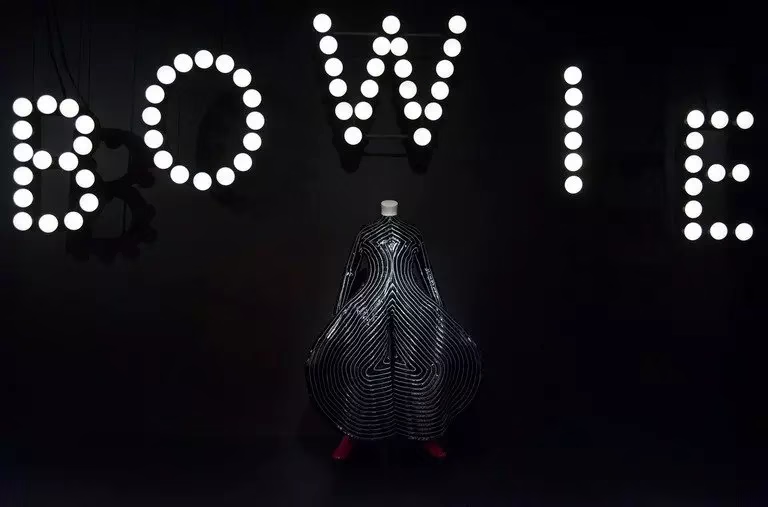
As you step inside the museum's exhibit and slip the provided headphones over your ears, you're transported into Bowie's world, where creativity is king and anything seems possible. The welcome display features his Tokyo Pop bodysuit against a stark black backdrop beneath "BOWIE" written in lights that appear to brighten as you approach. The headphones are on sensors and play different music and sound depending on where you're standing in the exhibit, giving the experience a personalized feel from the downbeat.
The journey begins with Davie Jones, as Bowie was originally named. From relics of his childhood in Brixton, London, such as the photo of Little Richard he held sacred as a kid, to his early paintings and drawing, to BBC footage of a 1964 interview about his newly formed Society For The Prevention Of Cruelty To Long-Haired Men, the exhibit shows the makings of a creative mastermind.
Jones played with the Konrads, the King Bees and Lower Third before releasing his first single as David Bowie with the Lower Third in 1965: "Can't Help Thinking About Me," which is on display in its original 7-inch, 45rpm form.
The exhibit then funnels through some keepsakes from Bowie's 1967 self-titled debut album into a space devoted to his 1969 single, "Space Oddity." Bowie launched his career in earnest and the character of astronaut Major Tom with "Space Oddity," which was released just days before the famous Apollo 11 mission launched. Bowie's play on Stanley Kubrick's 1968 film 2001: A Space Odyssey dovetailed perfectly into the public's fascination with space travel and the song became breakout hit.
<iframe width="620" height="349" src="https://www.youtube.com/embed/iYYRH4apXDo" frameborder="0" allow="autoplay; encrypted-media" allowfullscreen></iframe>
Back in Brooklyn, the homage to "Space Oddity" is complete with the original music video playing on a big screen next to Bowie's costumes from the era. As the song throbs in the headphones, you really feel you're witnessing the beginning of something special. The exhibit walls bear the theme in its title, "David Bowie is floating in a most peculiar way," and the lyric, "Planet Earth is blue and there's nothing I can do," reminds visitors how timeless and clever Bowie has been since the beginning.
The sprawling exhibit also explores many of Bowie's endeavors and reinventions with fantastic mirrored video installations, original drawings and paintings, lyric sheets and postcards, and lots of music. Of the many vibrant costume displays, Bowie's ice blue "Life On Mars?" suit stands out, having its own room where visitors can watch the music video, ponder the song's superhuman chord progression and cathartic melody, all while staring at the original getup Bowie wore during the shoot.
<iframe width="620" height="349" src="https://www.youtube.com/embed/v--IqqusnNQ" frameborder="0" allow="autoplay; encrypted-media" allowfullscreen></iframe>
The far end of David Bowie Is invites guests to remove their headphones and enter a special screening room engulfed in live performance videos. The footage is culled from what started as Bowie's 1974 Diamond Dogs Tour, which was described by one writer for U.K. publication Melody Maker as "the most original spectacle in rock" and "a combination of contemporary music and theater … several years ahead of its time."
The ambitious tour full of theatrical visuals took a slightly new direction after Bowie broke for two months to record 1975's Young Americans in Philadelphia, and returned without the elaborate set and a revised set list. It became The Soul Tour, sometimes referred to as "Philly Dogs." Footage from the Philadelphia show plays for the first time ever in this exhibition, and Bowie's commanding presence as a performer is inescapable as the video screens wrap around you.
For studio rats, a can't-miss fixture of the exhibit is the EMS Synthi AKS synthesizer Bowie used heavily during what Bowie called his "Berlin triptych," the three albums recorded after Bowie moved to Berlin: 1977's Low and Heroes and 1979's Lodger. The instrument was used to create some of the most groundbreaking sounds Bowie introduced at the time, and to stand up close to the actual unit is a powerful experience for tech-heads with a sonic sweet tooth.
True to its subject, the exhibit definitely has some rather unusual items on display. Take the "Verbaliser," for example, a computer program Bowie developed in the 1990s that chops up sentences into columns and scrambles them to create, as Bowie told it, "a kaleidoscope of meanings, and topics, and nouns, and verbs all sort of slamming into each other."
<iframe src="https://tools.applemusic.com/embed/v1/song/1053991925?country=us" height="110px" width="100%" frameborder="0"></iframe>
Of course, the exhibit features equally inspiring displays surrounding Bowie's most well-known projects such as his 1972 album The Rise And Fall Of Ziggy Stardust And The Spiders From Mars and the 1986 film Labyrinth, as well as artifacts from his memorable stage performance of "The Elephant Man."
In the darkest room of the exhibit, visitors can watch some of Bowie's buried treasure music videos such as the gorgeous "Thursday's Child" and the edgy "Little Wonder." There are also strange yet fun souvenirs, such as a tissue blotted with Bowie's lipstick from 1974 and a postcard from Elvis Presley sent to Bowie in 1976 during his tour in support of Station To Station, which wished him a good show.
David Bowie Is works as both a visually and aurally stunning representation of the boundless creativity that lived inside Bowie, right up to his final days. The exhibit's final room deals with pieces from his final GRAMMY-winning album, 2016's Blackstar, which was released just two days before his death. Considering how fresh and inventive the material on Blackstar sounds, there's no telling what the artistic boy from Brixton still had in his head and heart to share with the world.
<iframe width="620" height="349" src="https://www.youtube.com/embed/kszLwBaC4Sw" frameborder="0" allow="autoplay; encrypted-media" allowfullscreen></iframe>
A must-see for music fans in NYC, David Bowie Is will remain on display at the Brooklyn Museum through June 15. Tickets and other information can be found via the museum's website.
