
Earlier this week, Facebook announced two new Portal video chat devices designed to move the smart speaker experience to the screen and encourage virtual hanging out that feels authentic and casual. The "Hey, Portal" experience could become a new model for intimate and spontaneous engagement. For people who care about making music, this could reveal all sorts of unexpected new perspectives.
<iframe width="620" height="349" src="https://www.youtube.com/embed/oYaVm-lUkYc" frameborder="0" allow="autoplay; encrypted-media" allowfullscreen></iframe>
The family focus of Portal and Portal+ could help it be suitable for musical artists reaching out to fans. It's designed for what Facebook wanted but in a way that emphasizes giving everyone meaningful experiences that engage and connect them.
Facebook's increased 2018 emphasis on friends-and-family, as explained by Mark Zuckerberg early this year, has apparently been influential in Portal's design. That change to Facebook's newsfeed algorithms shook up major figures' social media strategies because of its emphasis on media that actively engages users.
The priorities Zuckerberg listed included meaningful relationships, connection, intimacy, community, well-being and personal moments. Portal's features work together to encourage just those kinds of interactions, and they could mean a new way to connect and collaborate for musicians and songwriters. The need for artists to represent a culture and community all their own — filled with people their fan base believes in and engages with — will apply to Portal-captured exchanges just as it applies more generally now to challenges such as getting on Facebook's newsfeeds.
The camera & mic: Many elements were thought through to help folks feel comfortable with a Facebook camera in their home. The Portal's on-board AI pans and zooms intelligently. A physical privacy shield clips easily over the lens and can also be used to disable the microphone, making the screen revert to displaying favorite photos.
Partners: At launch Portal and Portal + have been optimized for accessing Facebook Watch, iHeartRadio, Pandora, Spotify Premium, and more with additional partner announcements expected soon.
Filter fun: Portal's bedtime stories feature seems to point the way toward AR-enhanced, spontaneous music content that could be ahead. A story, its characters, and animated filters that can turn a selfie into a cartoon character are designed to let sleepytime storytellers stimulate and soothe children. The same fun that can help a kid fall asleep can be purposed for wide-awake entertainment. A musician can come equipped with an animated story and a cast of filter-characters when using Portal, which should be more fun with music too.
Privacy: On the back end, encryption through FB Messenger and Portal's other data routing is designed to reassure consumers made skittish by news of data breaches and criminal hackers. For example Amazon Alexa is on board for voice-activated use and keeps your interactions with it separate from Facebook's servers. Facebook also pledges not to view or retain the content of chats. The reason the camera-AI lives on-board Portal is so that less private data travels over the internet.
Price and product: The 10-inch Portal displays 1280 x 800 video and is available for $199. The 15-inch Portal+ displays 1920 x 1080 video, can be adjusted for portrait or landscape viewing, and costs $349. Available now for pre-sale, Facebook is also offering a promotional incentive of $100 off if you buy two. Shipments are expected to begin next month.
Competition: Amazon's latest Echo Show is built for similar tasks but with less of a "hanging-out" vibe designed into its specifications.
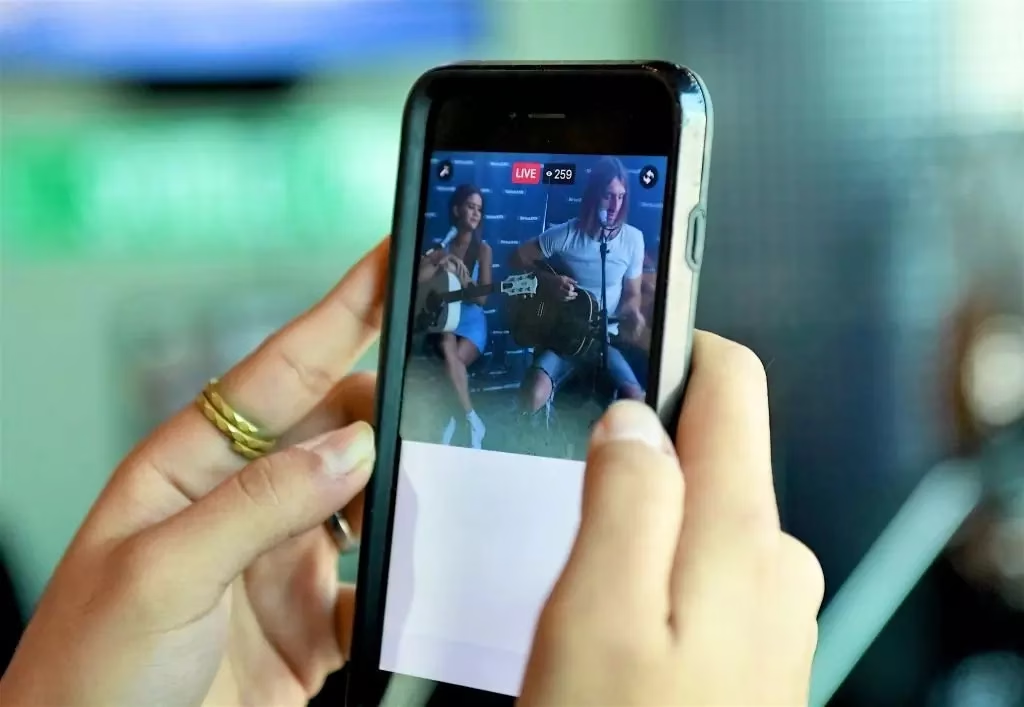
Like telephones, Portal's greatest power is enabling one-to-one meaningful experiences, which could include co-writing, lessons, or even rehearsing if latency is low enough. But also like mobile phones, video chat's power provides content that can be cast to wider audiences, making personalized performances and custom concerts other possible uses for musicians. Portal connections may stay intimate while being captured and still result in creation of conventional video content, while doing this in ways that feel more personal and spontaneous. It makes sense for Facebook's company agenda, and it's an interesting direction for artists too. Life in the social media spotlight has had drama and excitement of its own, and this could be a next step in its evolution.
The technology's implications may even reach into the media. Last month, The New York Times questioned the future viability of celebrity journalism because earnest sharing is replacing the perspective of an objective third-party biographer, for example when friends interview friends. Whether Portal ultimately enables one-to-many Portal-casting or not, captured feeds of celebs hanging out with close friends and being intimate and revealing online, in ways they can control, seems a format likely to attract both musicians as well as a growing audience.
