
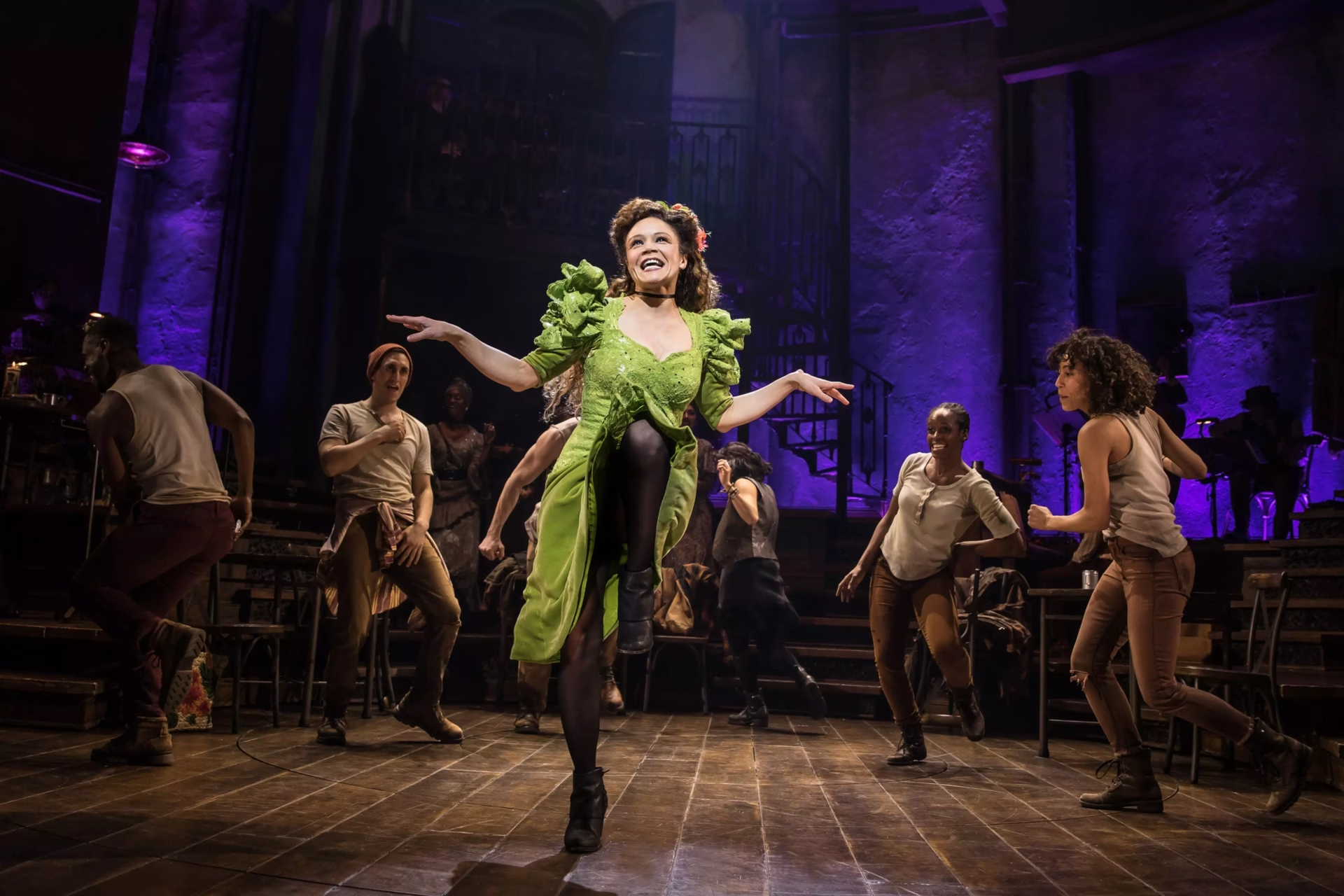
The traditional trajectory of a musical seeking to reach the Great White Way was that it would start as a local or off-Broadway production, go through multiple permutations of performance and development, find the right commercial casting choices, do an out-of-town tryout, and then, if the creators got lucky and the show thrived, arrive on Broadway. But some recent productions have been bucking traditional channels, finding audiences through original soundtracks available on CD and more prominently by streaming platforms like Spotify, which has allowed unorthodox shows like Hadestown and Be More Chill to skirt the usual gatekeepers and reach mainstream theatergoers in New York City.
Streaming is making a difference. During opening week performances of both Hadestown and Be More Chill, their audiences emanated incredible enthusiasm. This was beyond even the normal warm reception given new shows. Many people in those seats intimately knew these shows.
Writer/composer Anaïs Mitchell's Hadestown, a retelling of the Orpheus myth with both New Orleans and an industrial Hell as its settings, began life as an abstract, DIY community-style show in her home state of Vermont in 2006. Two incarnations later, she recorded a cast album in 2010 featuring vocalists Ani DiFranco, Greg Brown, Justin Vernon from Bon Iver, and Ben Knox Miller from The Low Anthem.
Andre De Shields in Hadestown
"It was a very magical collaboration," says Mitchell. That first cast album later lured director Rachel Chavkin and co-star Patrick Page to the project, which lead to productions off-Broadway and in Edmonton and London between 2016 and 2018. Later, Hadestown premiered on Broadway this past spring and won eight Tony Awards.
Mitchell does not seem to concern herself with streaming numbers on Hadestown (the Top 10 tracks on Spotify have notched up 7.6 million streams), but she notes that the three different recordings—the original concept album and off-Broadway and Broadway cast albums—"have definitely helped the show reach people who otherwise might not set foot in the theater. For all the complicated aspects of music streaming, I love that music is free. It's like water running to the sea. It will find the people who will listen to and love it, whoever they are."
The Hadestown creator adds that the process of developing the show over the past six years has been very public. "It's a little intense sometimes because people get attached to one version of a thing, and they inevitably have feelings when that thing changes," notes Mitchell. "But people have been incredibly supportive of the time it took to bring this show to Broadway. In a way people are invested in, and have really been part of, the journey itself, not just the destination. They’ve literally been part of the process."
Be More Chill
After the sci-fi teen comedy Be More Chill (adapted from Ned Vizzini's book) finished its four-week run at the Two River Theater in Red Bank, New Jersey in 2015, the original cast album was recorded to commemorate the experience. "No one ever thought that it would lead to having the show find a way back to a stage," admits composer Joe Iconis. But something unexpected happened.
"It was a perfect storm of things,” says Iconis. "There were a few shows around that time that had come out that had some audience crossover with us, like Dear Evan Hansen and The Lightning Thief musical. Through the magic of social-media algorithms, Be More Chill was suggested to people because of that." From their growing streaming audience, old-fashioned word of mouth built up interest. By August 2018, the offbeat musical Be More Chill, about a geeky teen outsider who swallows a supercomputer that seeks to turn him into a cool insider (with consequences), landed an off-Broadway run and then transferred to Broadway in February. It ends its official five-month run this Sunday, and a film adaptation is reportedly in development.
"The craziest thing when we were first experiencing this viral sensation was that kids who were listening to it just didn't know that it wasn't playing somewhere," recalls Iconis. "I would get messages every day being like, 'I'm confused. What theater is this that?' We had this bizarre thing where for the longest time we had this hit show audience without having a show. It was just these kids who knew it so well from the album."
The two soundtracks for Be More Chill have reportedly racked up over 300 million streams combined, with the older off-Broadway version accounting for a greater share of those. The show made enough of an impact that it was parodied on the opening sequence of the Tony Awards this year (although, oddly enough, the source material went uncredited). The musical was nominated for Best Original Score (Music and/or Lyrics) Written For The Theatre, the award for which ultimately went to Hadestown.
"When people first started discovering the show I would get messages, and I was just so thrilled that anyone was listening to the show at all," says Be More Chill writer Joe Tracz. "People were not just listening to it, but living with it and thinking about it and wanting to know more about the characters and the world. [This is] a show that's actually looking at whether technology is a good or a bad thing. The grand irony of Be More Chill is finding an audience through the Internet."
<iframe width="620" height="349" src="https://www.youtube.com/embed/QNtlNvR-5_o" frameborder="0" allow="accelerometer; autoplay; encrypted-media; gyroscope; picture-in-picture" allowfullscreen></iframe>
On the indie circuit, Buried composer Cordelia O'Driscoll says her offbeat show, about two serial killers who serendipitously meet on a date, has mainly built up an audience through over 70 performances in the U.K. and U.S. over the last two years. It was originally crowdfunded through Indiegogo for its 2017 debut at Scotland's annual Edinburgh Fringe Festival. Based on a book written by director Tom Williams, the show recently played at the New York Musical Theatre Festival in N.Y.C. Streaming has helped the show's creators find new fans as existing ones share the music, which she says has exceeded 200,000 streams, reaching many fans who do not live near where a current production is happening.
"In terms of what we've found out about our fans, it’s been interesting to see which songs have been streamed more than others, to see what music people are connecting with the most at certain times," says O'Driscoll. "It's an amazing way to start to understand audiences." The fun, irreverent show looks like it will continue to thrive and grow.
Other productions have been aware of streaming potential for musical exposure. Between their 2015 D.C. run and 2016 Broadway debut, the producers of Dear Evan Hansen released the streamable single "Waving Through A Window" which reportedly accumulated over one million streams prior to the show's N.Y.C. premiere. On the Broadway side, fans who have been waiting and clamoring for Hamilton tickets have repeatedly streamed its score and memorized it. They know the show before they have seen it. The full Hamilton soundtrack on YouTube alone has racked up nearly 10 million views.
"The new British musical Six has grown a huge following from the streaming of its album," says O'Driscoll. "The music is brilliant and works very well as a stand-alone album, so people are going to their shows already knowing all the words. It's really cool to see."
"It feels like with more musicians like myself coming to the theater from different angles, and being able to reach supporters by way of musical channels and not just theatrical ones, we all benefit,” says Mitchell. “It makes for more aesthetic diversity, and brings different folks with different tastes to Broadway.”
"When I was a kid, you'd find any musical by like digging through the musical theater section at Sam Goody or your local library, and you were lucky if they had like one Sondheim title," recalls Tracz. "The things you saw were restricted by what was there with physical media. Now with streaming, if you're looking to discover something new, you can find it. Or, even better, it can find you."
"Streaming has huge potential to significantly expand the reach of musical theatre, and remove the perceptions of elitism or exclusivity that some people think it has," says O'Driscoll. "It’s a very exciting time for musical theater."
