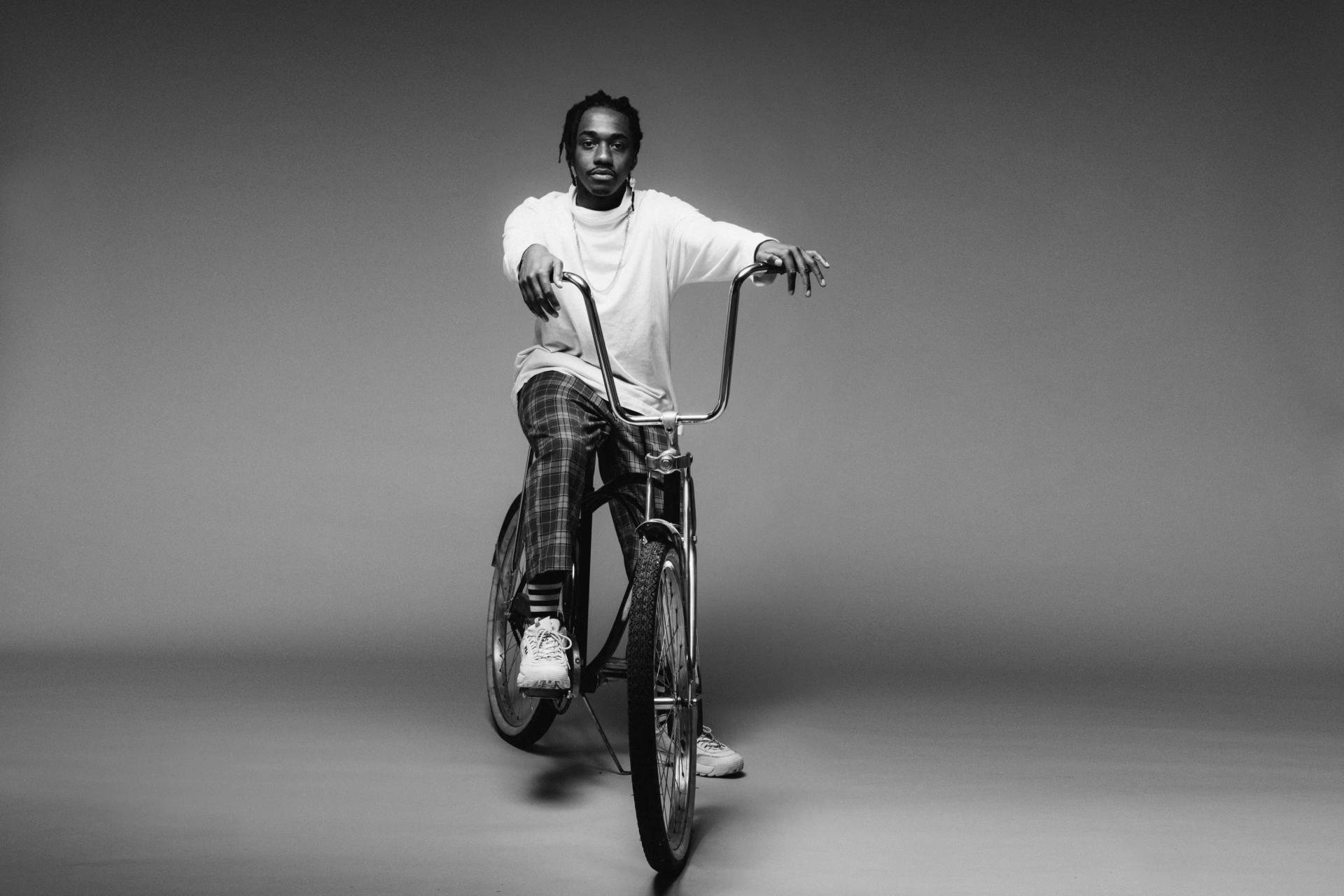
"I don't chase the wave, I just make the wave," sings rapper/singer Ric Wilson on the energetic, feel-good "Hang Loose." That's the Chicago native's exact vibe when it comes to music.
With his curious blend of "Nouveau" disco, hip-hop, church-inspired melodies and spoken-word poetry, Wilson's varied experiences forge a highly unique sonic aesthetic. He certainly has a way with words; his poetic approach to songwriting stands alone on the horn-accented "Yellowbrick," his latest single: "Me and you sound real good together/ Something that I never thought I would find, girl/ The way that you walk is all that I want/ And all that I need."
And when tackling tough subjecs like one's inner demons on "Sinner," his grooving beats evoke a sense of inherent optimism.
<iframe width="620" height="349" src="https://www.youtube.com/embed/seCB6ezlnNM" frameborder="0" allow="accelerometer; autoplay; encrypted-media; gyroscope; picture-in-picture" allowfullscreen></iframe>
Set to release a debut album this year, Wilson has only delivered a small slice of what he's building up to with EPs BANBA and Negrow Disco. The Recording Academy spoke to the rapper before his set at Pitchfork Fest about his festival debut, his album in the works, his roots and more.
We're at Pitchfork Fest, in your hometown of Chicago. How's it feel to be performing here tomorrow?
It feels great. This is my first festival I ever went to. Ever. It's my favorite festival, too, because of that. I could never afford to get in, really. I used to, like, sneak in. It's crazy. I'm very, very lucky. I've had a lot of selfless people help me to get to places. I'm very appreciative.
You recently released the video for "Yellowbrick." What was the inspiration behind the video?
I kind of wanted to bring people to my Chicago world. I kind of wanted to make a love song that wasn't so corny. That wasn't so serious. So I made it quirky. [Laughs.] And I brought some dolls in. And I kind of wanted to talk about how, I dunno, I wanted to have, like, a black muppet in the video. I wanted to have a little puppet love story. Like, puppy love slash puppet love.
That's the inspiration for the video. Then for the song, it was someone I was falling in love with a couple of years ago, fell out of love with them, and then I finished writing the song about somebody I fell in love with now. When I recorded the song three years ago, I didn't like my voice. I didn't know how to use my voice. The voice is like an instrument; I didn't know how to use it. And just recently this year, I got really comfortable with my voice, comfortable on the mic. I'd be crooning, and it sounded pretty decent, so I decided to go with it.
What was the moment where you realized you were comfortable with your voice?
I did a song called "Split." No, I did a song called "Love Away," actually, on my last project, BANBA. And I was like, rap-singing, and I actually re-recorded it. I was actually like, really crooning-singing. And it sounded really good! So I kept it. And that inspired me to do that more on tracks.
How did you get your start in music?
I grew up at open mics here in Chicago. That's kind of how I started and branched off into other things. I was part of YCA [Young Concert Artists]. I also went to You Media. You Media had an open mic called Lyricists Loft.
How did YCA inform your music? A lot of artists have come out of it... Chance The Rapper, for example.
Yeah, different people came out of it. One of my favorites to come out of there is Noname. She's a rapper out here in Chicago. It's inspired me because you can make something that sounds good sonically, but word-wise, what are you saying? You always have to be saying something. Every song has to be about something. It's about love, it's about shaking your booty. Commit to it and write to it. Do it witty, do it clever and do it cool.
You've spoken about people not understanding or realizing that rap is poetry. Can you elaborate on that?
Oh, well rap is poetry. It's words. It's rhythm and flow. Rap is literally like a poem that you're saying with rhythm and with a particular flow on a particular beat. [First] there was poetry, then poetry became spoken-word. With Gil Scott-Heron, with Muhammad Ali. They used to do like, little funny raps in his commercials. You got The Last Poets, and sooner or later some kid started sampling soul tracks and making beats. And then started doing that spoken-word over those beats, and that became rap.
Everyone has their own poetry. Everyone should do their own poetry and own it. It's cool.
<iframe width="620" height="349" src="https://www.youtube.com/embed/6gKSkbuGwZw" frameborder="0" allow="accelerometer; autoplay; encrypted-media; gyroscope; picture-in-picture" allowfullscreen></iframe>
So, you grew up in the church. How has that setting influenced your sound?
Well, it's helped me learn rhythm for sure. It's real soulful. It's super-duper soulful. I think I know if I'm singing good or not because I grew up around a lot of church singers who are really good at singing. So that's a priveledge that I have. I don't ever have to record with Auto-Tune. When I'm singing or rapping, if I can't get the tune right live on the mic, then I don't want to do it at all, because that means I can't perform it right. It has to be natural.
Does the song "Sinner" have any connection to your growing up in a church environment?
I grew up in the church and I know what sinning is... "Sinner" is just about the idea of sinning and what that is, and how everybody's kinda doing it. "Sinner" is like a big confession song.
As an activist, how would you encourage someone to give back to their communities?
The world is at your hands. You can get on Twitter or Instagram and say anything. And that's activism. Being active. I guess I'm like a pop-up boy now. I used to organize a whole lot. I went to Geneva, Switzerland, to the UN and all of that stuff, when I was 19. And I haven't really been actively organizing. So I don't know if I would even call myself an activist right now. I'm just a mouthpiece. I'm a kid that grew up in an activist community of critical thinkers, and I was priveledged in that. I'm just a mouthpiece of all of the people who have influenced me and been selfless enough to teach me about the issues of the day.
What else did you listen to a lot growing up?
A lot of Motown. I like to listen to a lot of Stevie Wonder. I liked a lot of Disney songs. Lots of Cartoon Network songs. Lots of movie soundtracks.
Are you going to check out the new Lion King?
I'm going to check out the new Lion King, yeah. This is the second time I've actually known someone in The Lion King. My cousin, Jason Weaver, was the voice of the original Simba, singing. So that's my famlly right there. And now Chance is in it, so that's cool.
How would you describe what you call your sound, "Nuevo Disco"?
Aw man, I was thinking about disco music and how it was started by queer black and brown folks. They were marginalized in spaces to have fun and be themselves. And from those spaces, out came disco music. And I think that's really cool. Where I'm from in Chicago, and my group of friends, what Sylvester makes me feel like, if I want to do disco music, I want to do the Negro disco. Not like the Bee Gees. Not the disco music that got appropriated. Not like "Saturday Night F**kin' Fever." I want to do Sylvester. I want to do MFSB. I want to do the disco queens.
You're working on your debut album—what can we expect from that?
It's gonna sound like the new Chicago rap sound, some of the new vibrations coming out of that. I want it to sound like a Hebru Brantley painting meets a Basquiat painting meets a Curtis Mayfield song. Like, if Stevie Wonder started rapping all of the sudden.
Pitchfork Fest's Adam Krefman On Lineup Diversity, Reasonable Prices & More
