
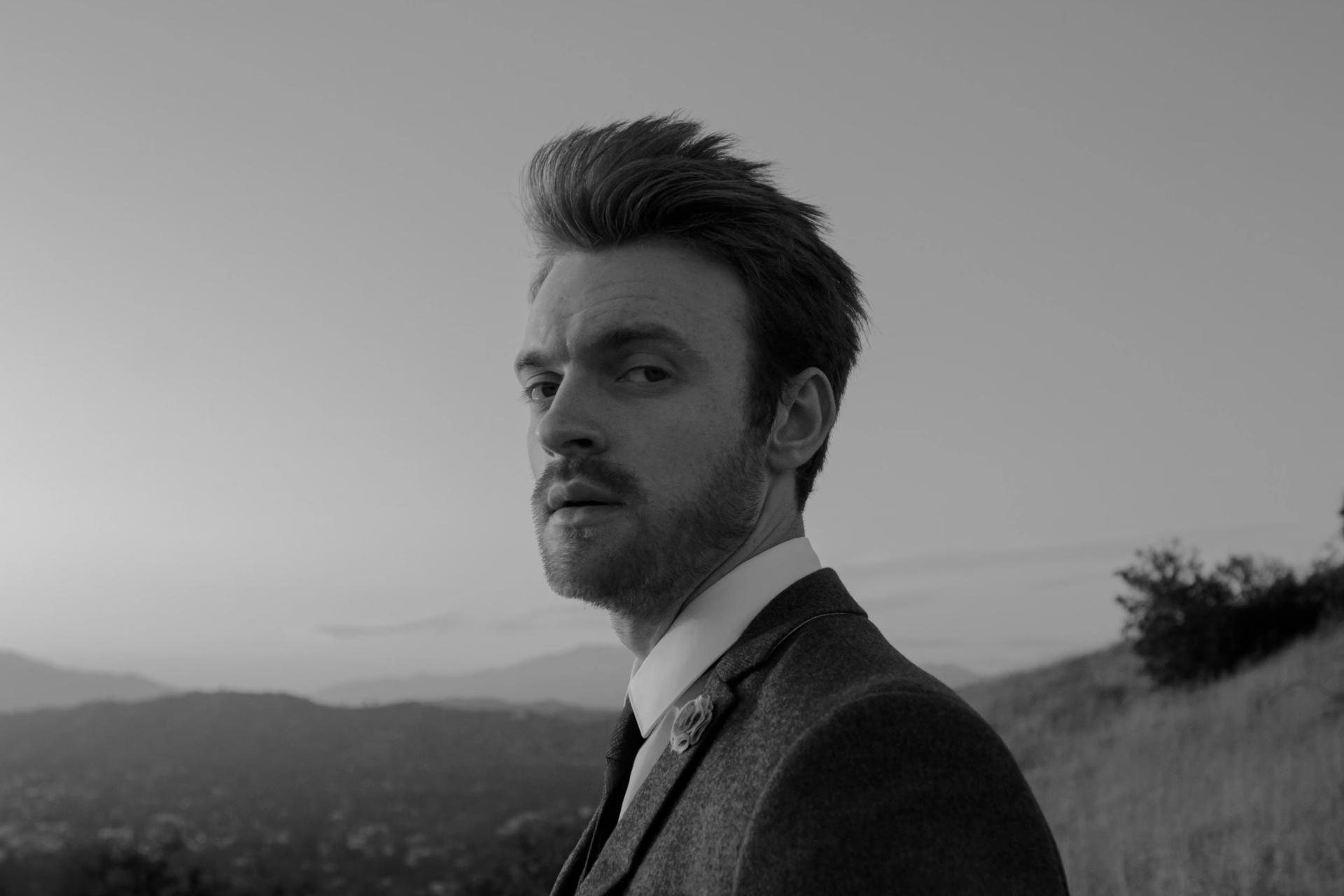
If you followed L.A. pop wunderkind Billie Eilish's exploding career over the last few years, you no doubt are also familiar with her super-producer brother, Finneas O'Connell, who goes by the stage name FINNEAS.
The 22-year-old, who produced all of Eilish's haunting bedroom-pop debut WHEN WE ALL FALL ASLEEP, WHERE DO WE GO? from the comfort of his own tiny childhood room in Highland Park, is also on a collision course with the upper echelons of fame. Since the enormous success of WHEN WE ALL FALL ASLEEP..., not to mention its preceding singles and Eilish's 2017 EP, Don't Smile At Me, FINNEAS has become an industry household name, with five 2020 GRAMMY nominations (including Producer Of The Year, Non-Classical), high-profile collaborations with established pop royalty (he produced Selena Gomez's "Lose You To Love Me" and two tracks on Camila Cabello's latest album, Romance) and a burgeoning solo career all of his own, having released his first EP, Blood Harmony, in October. And that's all on top of being the youngest person to be nominated for Producer Of The Year since Lauryn Hill, who was 23 when she was nominated for The Miseducation Of Lauryn Hill in 1998.
If the swarm of attention has affected FINNEAS, you wouldn't know it. When we hop on the phone to talk about his and Billie's first-ever GRAMMY nominations, he's casually out walking his dog, Peaches. When asked about his hyper-minimalist production style, where most of Eilish's songs sound near-whispered against a series of spare, tip-toeing beats, FINNEAS just says that he's not afraid of a little empty space. His main goal, ultimately, is to place the artist's vocal front and center. "It's like a room with furniture," he says. "To me, my favorite bedrooms just have a bed in them, you know what I mean? Like, you don't need lights, 16 pillows and, you know, armchairs and sh*t. You could just have a bed."
In the lead up to his and Eilish's first time at the 2020 GRAMMY Awards, happening on Sunday, Jan. 26 at 8 p.m. ET on CBS, FINNEAS told the Recording Academy a bit about his reaction to earning five GRAMMY nods, his favorite past GRAMMY moments and why he doesn't necessarily want to work with his favorite artists.
Congrats on all of your nominations! Where were you when you heard you were nominated?
I was asleep the second they came out, but I did wake up quite early. I woke up at like 6:45 a.m. and was like, 'Oh God, Oh my God, they're out." I've described it to people as like, the same feeling as like falling asleep on Christmas Eve except for like you might wake up and have no prep. That's kind of the line.
At what point did you connect with Billie to tell her?
I called my mom like, "You guys get Billie" and mom was like, "Billie's still asleep." I called Billie back later.
To what extent do your nominations feel validating? You recorded WHEN WE ALL FALL ASLEEP, WHERE DO WE GO? in your bedroom. I expect the industry Powers That Be were eager to get Billie in a giant studio with a bunch of big-name producers.
Well, you know, we were doing okay before the album. We had an EP [2017's Don't Smile At Me] that did pretty well and we were going on tours, and so we were feeling really good about ourselves. There were really great producers that were interested in working with us. And that was appealing to us because we love so much music and sometimes the producer would reach out and they would have made music that we loved in our childhood. And it's like, "Oh my God, we should meet with them." Truth be told we were open to it but every time we would work with other producers and other songwriters on our stuff, it just was never very good. It just didn't work very well. And whenever we worked alone, we made all the stuff that we were proud of, that we're excited about.
And I think the GRAMMYs, I couldn't feel more honored and it couldn't be more meaningful to me because it's such a celebration of the actual creative process. And I think the other cool thing that I feel very proud of, it's like, you know, very rarely now are producers doing entire records or even entire songs. Like, [there will be] two or three different producers for a song, 20 producers on the album, and Billie had only one. And I'm very proud of that. I'm really proud that it's just me and her figuring it all out, making sure it was exactly how we wanted it to be. That made me feel really good.
<style>.embed-container { position: relative; padding-bottom: 56.25%; height: 0; overflow: hidden; max-width: 100%; } .embed-container iframe, .embed-container object, .embed-container embed { position: absolute; top: 0; left: 0; width: 100%; height: 100%; }</style><div class='embed-container'><iframe src='https://www.youtube.com/embed/DyDfgMOUjCI' frameborder='0' allowfullscreen></iframe></div>
I think that's really true. In the past, you could directly attribute popular albums to one producer. And today, popular albums feature a mixed bag of sounds and personalities.
All the albums that I grew up listening to were produced by one person. One producer and now it's like dozens of producers on each record, you know?
Totally. But then on the other hand, we’re living in a time where albums don’t necessarily need to sound cohesive to be marketable. The end goal, from an industry perspective, is to get individual tracks on whatever Spotify or YouTube playlist is trending.
Well, Billie and I like eclectic music. Like, our records have a lot of mix. I think it's more like, if you do an album with 12 different producers, you're going to sound like someone else's album because those 12 different producers are going to do other people's records too. That always puts me out, you know?
That makes a lot of sense. Well, speaking of other peoples' records, now you've worked on "Lose You To Love Me" with Selena Gomez and "Used To This" and "First Man" with Camila Cabello. What do you look for when considering working with different artists?
I usually let it just be really natural. Like if an artist makes something that I love, I'll just reach out to them, and say like "I love your music." And then if they like what I do, they write back and say they're fans. Then we'll make something together. But I'm not very, like, thirsty. Like I don't try to work with artists because I think it would be a good career opportunity. I only want to work with people that make music that I love, like Camila, I truly love her first record. I just thought it was so cool and I thought, I just wanted to make an album with that artist. I saw her play live and I was blown away. I just thought she was a true pop star.
What makes a true pop star, in your opinion?
I think people who feel like they have something to say to me and people who have a really unique thing about them, whether it's a unique voice or a unique opinion, or unique life story, you know? Just something that really pulled me into them and makes me feel like they're telling a story that I want to listen to.
One thing that stands out about WHEN WE ALL GO TO SLEEP is that, unlike so many of its peers, it’s the sort of record that sounds best in headphones. Is your production minimalism influenced by anyone?
Well, I mean there are so many producers that inspire me. I used to try to imitate production by certain people. And now I'm only interested in doing the opposite of that. I'm only interested in doing production that like no one's ever done before.
But yes, [I love] Kanye West, Timbaland, Rob Cavallo. So many producers are so good but I’m only interested in carving out my own thing, which seems to be the minimalist approach of making room for every element. You know, it's funny like talking a lot about me being a minimalist producer and really like there's a lot of layers but they're all out of the way of the vocal. I'm mostly just trying to make so much room for the vocal.
<style>.embed-container { position: relative; padding-bottom: 56.25%; height: 0; overflow: hidden; max-width: 100%; } .embed-container iframe, .embed-container object, .embed-container embed { position: absolute; top: 0; left: 0; width: 100%; height: 100%; }</style><div class='embed-container'><iframe src='https://www.youtube.com/embed/HJq3m-Ck2FI' frameborder='0' allowfullscreen></iframe></div>
Yeah, I get the sense that many producers get nervous about unfilled space, if you will. Kind of like when you’re having a conversation with a quiet person and you automatically feel like you need to talk a little too much.
Totally. People are just trying to fill up the whole thing. Like it's a room with furniture. To me, my favorite bedrooms just have a bed in them, you know what I mean? Like, you don't need lights, 16 pillows and, you know, armchairs and sh*t. Like you could just have a bed.
So, I imagine all of this GRAMMY recognition has put you on a lot of artists' collab wish lists. Is there anyone you haven’t worked with yet that you’d like to? Who's on your wish list?
I don't actually have one anymore. I used to but I don't have one anymore. I feel like the thing that I've learned a lot is when you're involved in something, you don't always get to appreciate it for what it is as much. You're focused on the details and how you can make it better. It's kind of torture. I felt really lucky in that I've gotten to know some of my favorite artists; I get to tell them how important they are to me. But that doesn't always make me want to work with people. I feel like if I'm going to work with somebody, it's because I feel like I actually have something to add to them. Like, I don't have anything to add to Paul McCartney. You know what I mean? It's Paul McCartney, he's doing fine. I'm happy to just be a fan and go to the concert.
How do you envision splitting your time between working with artists and developing your solo work?
Well, I work with other artists sort of seldom, I'll do like a couple days a month with other artists. I try to be really careful about them. And then I work on Billie's stuff whenever she wants to. Whenever she's inspired, whenever she has something to say, whenever we're trying to finish something, I work on her stuff. And then whenever she doesn't have time or she's done a photoshoot or she's burnt out, feeling uninspired, I'll go work on my own stuff.
You and Billie have talked a lot about watching the GRAMMYs from your living room at home in previous years. What was one of your favorite GRAMMY moments?
Man, every time Bruno Mars has ever performed, I've been so into it. There was that one performance several years ago that was Lil Wayne and Drake and Eminem and I remember just watching that and my head exploding.
Keep up to date on all the latest 2020 GRAMMY performers, presenters and host news here, and be sure to tune in to the 62nd GRAMMY Awards on Sunday, Jan. 26, 2020, and broadcasting live on CBS at 8 p.m. ET/5 p.m. PT.
