
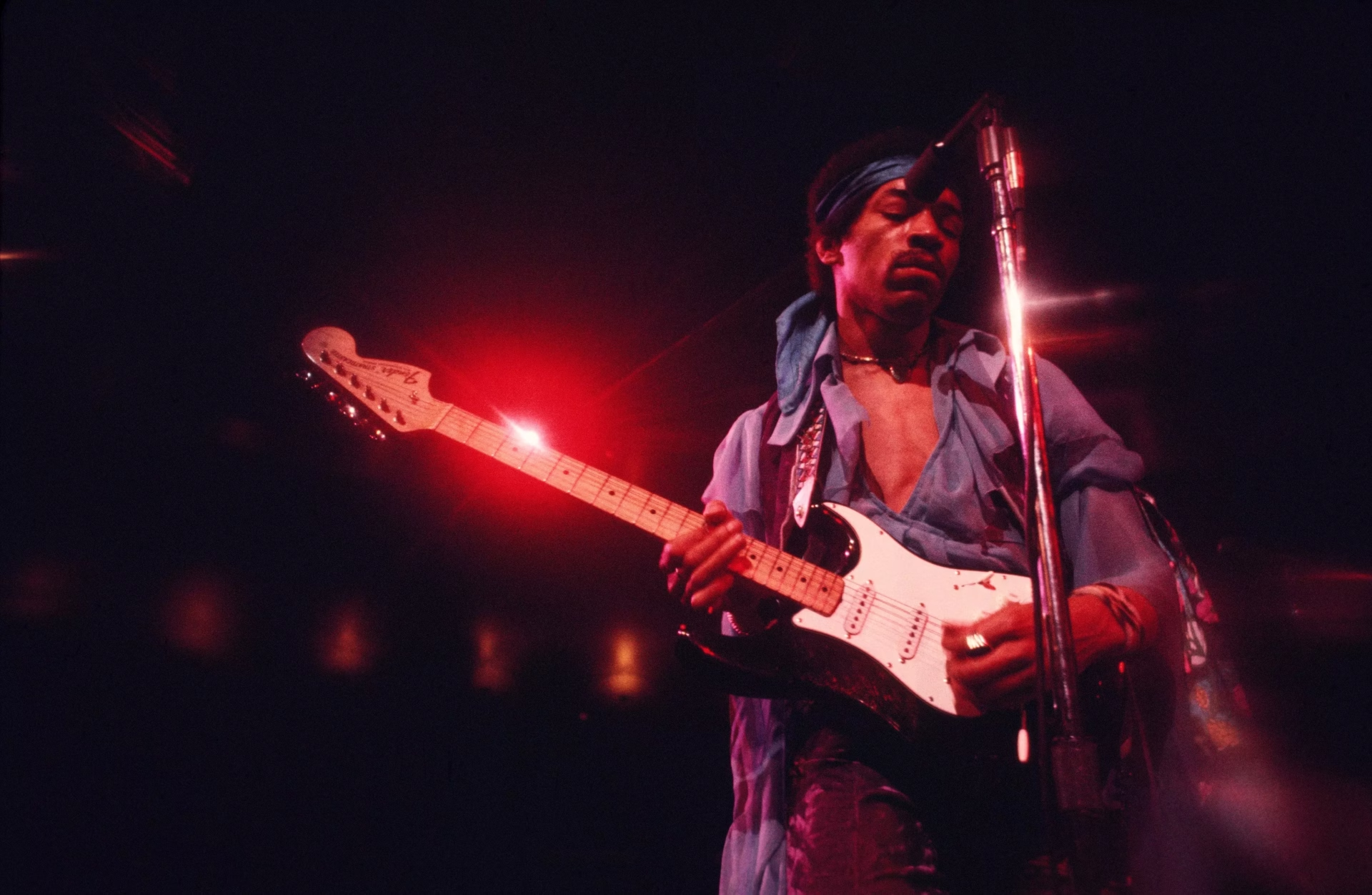
Released just months before the legendary pioneer's passing at the age of just 27, Jimi Hendrix's Band Of Gypsys gave the world a heart-wrenching look the iconic guitarist's limitless well of talent still to be explored.
<iframe width="620" height="349" src="https://www.youtube.com/embed/4Vsl6w9Nw6w?rel=0" frameborder="0" allow="autoplay; encrypted-media" allowfullscreen></iframe>
Clocking in at over 45 minutes with a tracklist just six entries long, Band Of Gypsys marked a departure of sorts from Hendrix's traditional brash, psychedelic hard-rock sound and a transition toward the more blues-oriented improvisational sounds that were both the foundation of the guitarist's roots and the new direction of his musical goals. Ultimately, the album would lay the groundwork for the elements of proto-funk fusion that would come to define the next decade of popular rock.
In honor of the album's inclusion with the 2018 class of GRAMMY Hall Of Fame inductees, here are five intriguing details about Band Of Gypsys that you may find surprising.
1. First Recording Without The Experience
Prior to Band Of Gypsys, all of Hendrix's studio releases were recorded with the same core musicians. Together with bassist Noel Redding and drummer Mitch Mitchell, Hendrix introduced himself and his band to the world as the Jimi Hendrix Experience. The trio released all three of the albums — 1967's Are You Experienced, Axis: Bold As Love, and 1968's Electric Ladyland — that made them icons of psychedelic rock over a period of less than 16 months. But by late 1969, Hendrix was still under pressure to come up with a follow-up to Electric Ladyland, as well as to satisfy a contract dispute with a former manager that stipulated another LP of material be released. As Redding had departed the group for personal reasons in late 1969, effectively disbanding the Experience, Hendrix sought out frequent jam partners Billy Cox (bass) and Buddy Miles (drums), and the Band Of Gypsys was born. The band's 1970 live recording at the Filmore East in New York that became Band Of Gypsys was Hendrix's first-ever recording released without the Experience as his backing band.
2. The Woodstock Connection
As well as serving as a frequent jamming partner when Hendrix was in the mood to explore his more blues and R&B-leaning tendencies, bassist Cox also played in the interim backing band that took the stage with Hendrix at Woodstock in 1969, loosely known as Gypsy Sun And Rainbows. Following his rejoining with Hendrix to help form Band Of Gypsys for a series of shows in 1970, Cox would continue to play with Hendrix as a member of the Cry Of Love band. With original Experience drummer Mitchell rounding out the lineup for the Cry Of Love trio, the group would eventually be known unofficially as the New Experience, leading later fans of the band to incorrectly believe that Cox was an original member of the Jimi Hendrix Experience. As of today, Cox remains the only surviving member of Hendrix's three main backing bands (the Experience, Band Of Gypsys, Cry Of Love).
3. Miles Ahead Of His Time
Drummer George Allen Miles was given the nickname "Buddy" by his aunt at a young age, after the famously temperamental jazz drummer Buddy Rich. His father had made a career playing upright bass with a variety of famous jazz players, including Duke Ellington and Charlie Parker — the latter a frequent collaborator of Miles' namesake Rich. Miles first jammed with Hendrix at an impromptu practice session held at a home owned by Stephen Stills (of Crosby, Stills And Nash) sometime in 1967. He would encounter Hendrix for similar one-off sessions on both U.S. coasts over the next year, but it wasn't until early 1970, just after his own band Buddy Miles Express had dissolved that Miles go the call to come join the new project Band Of Gypsys. While his time with the Gypsys remains some his most-known efforts, Miles would go on to build a truly impressive résumé, playing with artists as varied as Carlos Santana, Mike Bloomfield, jazz guitarist John McLaughlin, Neal Schon of Journey, and even Phish. Fun Fact: Miles also sang the lead vocals for the famous "California Raisins" claymation commercials in the late '80s and early '90s.
4. The Way Of The Gun
<iframe width="620" height="349" src="https://www.youtube.com/embed/AJw_XqvsSIs?rel=0" frameborder="0" allow="autoplay; encrypted-media" allowfullscreen></iframe>
The crown jewel of Band Of Gypsys is, of course, "Machine Gun." The 12-plus-minute spacey, experimental track served as a lengthy sonic commentary on the Vietnam War — and perhaps also all conflict, whether internal and external, if one takes into account the short dedication speeches Hendrix would typically recite prior to launching into nearly every recorded live performance of the song.
Opening with sparse, blues-influenced playing that many still call the best work of Hendrix's career, the track melts slowly into a series of restrained, effects-driven improvisations that seem aimed to simulate the dissonant battlefield overtures of helicopters and gunfire, while Hendrix himself breaks down his central plea, "Machine gun/tearing my family apart/…/Don't you shoot him down/he's about to leave here." Now considered one of the guitarist's crowning achievements and painful reminders of the creativity that still was to come had he survived, the opus of radical improvisation was recorded live numerous times at various performances, but never officially tracked in the studio. It stands now as a testament to the strength of Hendrix's musical expressivity
5. A Legacy Of Funk
In the face of the huge anticipation for a follow-up record to the critically acclaimed Electric Ladyland, Band Of Gypsys initially received somewhat mixed reviews from the public over the inconsistency of some of the recordings, as well as the lengthy departures from the trademark sound that had made Hedrix and the Experience famous in the first place. But in retrospect, it seems clear that the record, as the final creative output of an artist forever known for pushing boundaries and seeking the distant edge of the state of his craft, served instead as one of the earliest blueprints of the coming decade of popular rock music. The effects-heavy yet expertly restrained musical abstractions formed the influential basis of much of the 1970s' best-known blues-rock, while also informing the earliest experimentations in uptempo funk fusion that would later make acts like Parliament famous. Throughout the '70s, and even into the over-produced sheen of the '80s, and the eventual alt-rock revival of the '90s, the story of the sonic legacy of Band Of Gypsys is a book that is still being written to this day.
