
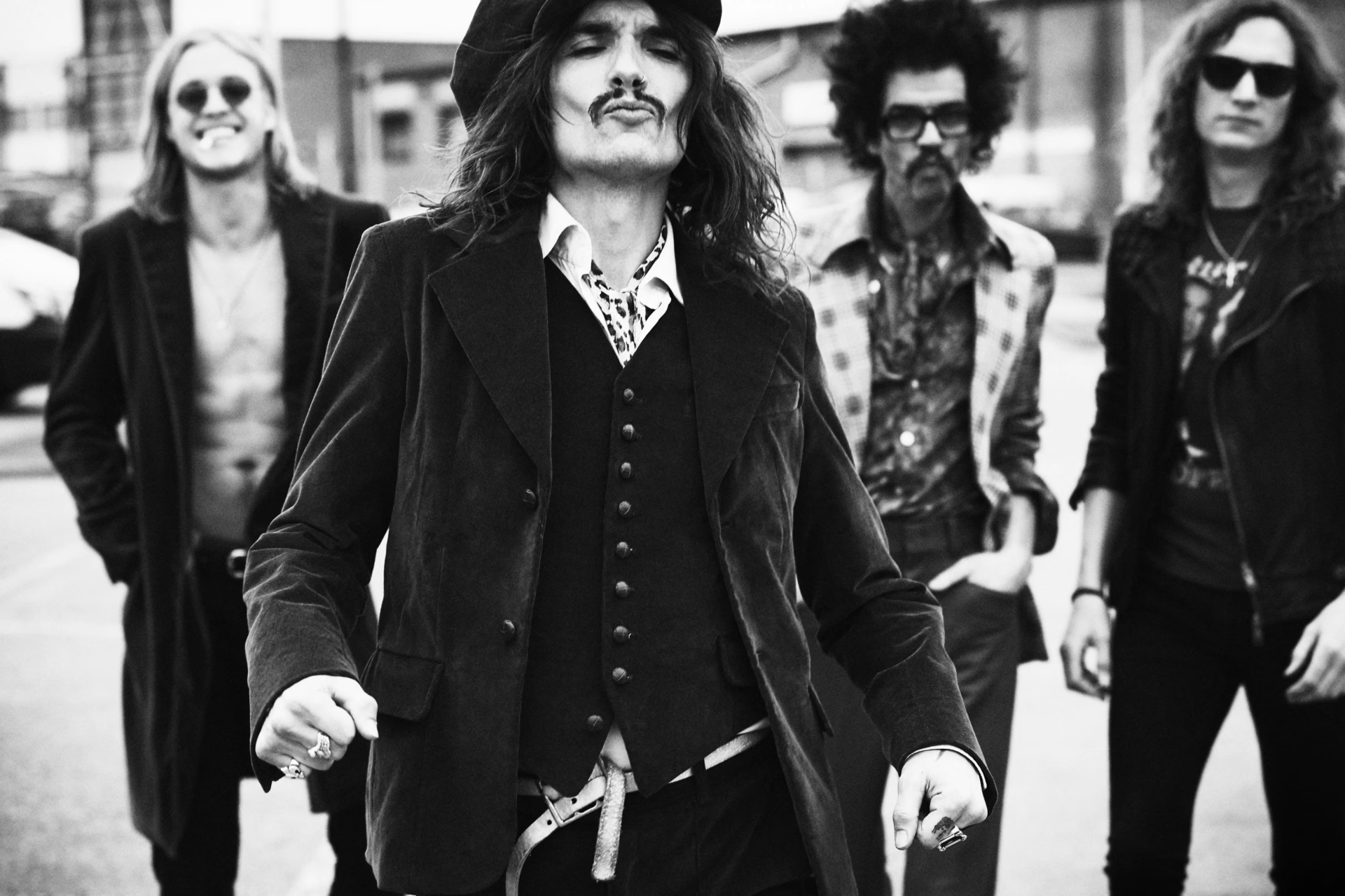
Most will remember U.K. camp-rock maestros The Darkness from their early aughts days with lead singer Justin Hawkins croon-chanting, "I believe in a thing called love: JUSTLISTENTOTHERHYTHMOFMYHEART!" Well, the quartet have been steadily producing records since their rollicking 2003 debut, Permission To Land, save for a hiatus between 2006 and 2011.
These days, Hawkins, his brother and guitarist Dan, bassist Frankie Poullain and drummer Rufus Tiger Taylor are fresh off of releasing their sixth studio album, the impishly titled Easter Is Cancelled, which, according to Hawkins, came from his going down a rabbit hole of savior-themed "what ifs."
"Let's imagine a universe when Jesus decides on the day of the crucifixion that he's not having that after all and he's going to use his supernatural God-attributed gifts to escape," he tells the Recording Academy over the phone. "And then I suppose the thinking is, what kind of world is it after that? Is there poverty? I suppose nobody else would get crucified either. I think that that that'd probably be the last time anybody's crucified. And that's just a kickoff."
Below, Hawkins delves further into the ideas behind Easter Is Cancelled, the current state of rock and roll ("there's a real appetite for quality rock; there just isn't any quality rock") and why the Darkness, despite the viral nature of their debut single, will never be in the business of creating "content."
<iframe width="620" height="349" src="https://www.youtube.com/embed/T5yEtElBgyU" frameborder="0" allow="accelerometer; autoplay; encrypted-media; gyroscope; picture-in-picture" allowfullscreen></iframe>
How does Easter Is Cancelled stand apart from your previous work?
Well, the last studio album was our first foray into writing with Rufus [Tiger Taylor] as a legit member of the band. And so a lot of the stuff on that last record is just us trying to have fun and all of us are accepting things that we don't think are necessarily world-beatingly brilliant, but they're fun to play and it is good for the relationship. And it was a good document that shows where we were at that time, but I think this one is all of us going, "Right, f**k, we're going to make something amazing and we won't stop until we've done that." And I think that comes across. We really did not compromise on anything. If one person had anything vaguely negative to say about any part of any song, it just disappeared, never to be seen again, locked in the vault to be used as a BBC Sports theme at some point in the future.
We spent eight months doing that and came up with an album that doesn't sound, to me anyway, doesn't sound self-indulgent. Or if it does, it sounds self-indulgent in the right away. It doesn't sound like we've become an elfin tribe, it still sounds like a rock record.
I read some interviews that you did while preparing to release the previous record. There was some commentary about how it sounded a little bit harder rock, more metal. And I didn't really get that impression from the sound on this album.
You know what? I think the reality is that I just say words and I don't always mean [them]. I met somebody recently who just looked at me and said, "You lie all the time, don't you?" I was like, "Yeah, thanks." I love somebody who appreciates what I really do.
It's hard in promo because I didn't know what to say about the last record, really. And also, I think your perception of it's a little bit different when you've been working on it closely. I think I was probably referring to “Japanese Prisoner Of Love.” I probably had that in my head, thinking, "Oh, yeah. This'll be heavier than we normally do, isn't it?"
Well, I do think your fan base enjoys how the Darkness leans into the campier side of rock, never appearing to take yourselves too seriously. But a lot of the themes and the ideas on Easter Is Cancelled are more serious. And in the promotional materials, you talk about how you have a responsibility to change the establishment. Do you see your role in the industry differently now than you used to?
Well, I saw a talk that Todd Rundgren did a few years ago, and I love Todd Rundgren's music and I wanted to see him and talk about music. And he said something that really stayed with me: it was that music used to be a product and then now it's a service. And I think that just sums it up, doesn't it? We've all regressed to being minstrels at the beck and whim of whoever is going to pay enough... I don't know what the currency would be, doubloons, enough doubloons to buy the puffy trousers that we want. And that's a long-term effect. You've got Coldplay with the puffy trousers because they're getting all the doubloons and then we'd probably be somewhere down the long tail eating mud. And that's the reality of that status and also the nature of the music trade. The last concern of the whole infrastructure is, "how is the musician going to make money?" Who cares?
<iframe width="620" height="349" src="https://www.youtube.com/embed/fMWF3H6EIpA" frameborder="0" allow="accelerometer; autoplay; encrypted-media; gyroscope; picture-in-picture" allowfullscreen></iframe>
You guys kind of came up at a time when musicians made money in arguably a more straightforward way, via album sales. But you've been around long enough now to see the economics shift and change. Have you had to change the way you monetize yourselves as musicians?
We've refused to [change]. We've gone through a few different managerial changes. We can't get our heads around the concept of "content," and we're not interested in doing that.
As vacuous and as daft and as whimsical as I seem, I am actually quite a serious person when it comes to the arts, and I feel like making albums is what I grew up wanting to do and doing YouTube videos of some people farting or whatever it is, I'm not interested in that and I'm not interested in Instagram, Twitter annoys me. I understand why in order to monetize your existence as a musician you need to have a firmer sense of ownership from your fans, but that offends me. You know?
I feel like you're supposed to be free to express stuff, not just be what your fan base wants you to be, because you should be a viable artistic entity even if it means losing your fan base. You should always run that risk and you should never be afraid of it. I feel like making an album is like painting a picture. That simple, isn't it? It's like somebody says, "People aren't buying pictures anymore. What they're buying is some Etch-A-Sketches that have been varnished." What kind of person puts down the paintbrush in that instance and then starts Etch-A-Sketching? And the answer is somebody who isn't a true artist, somebody shouldn't be f**king holding a paintbrush in the first place. They should be, I don't know, doing something else.
Doubling back for a second, can you elaborate on what actually led to the name Easter Is Cancelled?
It came about because I was asked to do some poems and write down all of my lyrics over the years and make a book, which would be a stocking stuffer for the hardcore Darkness fan. I wasn't that interested in doing it because I like singing songs. I don't like doing books. Never done a book before, not that interested in doing it, really. So I just said, "I'm writing an album. Can we do this next year or something?" And they went, "Well, what about Easter?" And then, "You can do an Easter poem." I was like, "Okay." And I wrote, "Wishing you Easter pleasure that you cannot measure with a ruler bula bula." And I just sent it off and I got an email back from my manager saying, "Easter is cancelled."
That was how that started. And then I thought, "Well, Easter is cancelled. Let's have a think about that." And I did an internet search for "buff Jesus" and I found a Boris Vallejo piece of artwork with a buff Jesus broken down from the cross and I thought, "Well, why stop there?" Let's imagine a universe when Jesus decides on the day of the crucifixion that he's not having that after all and he's going to use his supernatural God-attributed gifts to escape. And then I suppose the thinking is what kind of world is it after that? Is there poverty? I suppose nobody else would get crucified either. I think that that that'd probably be the last time anybody's crucified. And that's just a kickoff.
Have you gotten any pushback from religious types?
[Yeah], I was disappointed when people assumed that it was intended to shock. Because I feel like if it's 2019 and then the thing that you're shocked about is a rock band misappropriating some religious iconography that's been around since f**k knows when, then you need to close your laptop and have a look around you. It's mental. It's mental to be upset about that kind of stuff, and I never considered for a second it would shock anybody. And I think most people claim not to be shocked, but only to be disappointed.
And then I just have to ask, well, what were you hoping for, then? Were you hoping for, for example, a rehash of Appetite For Destruction where there's the four faces of The Darkness on a cross? Because that's still a cross. Or were you hoping for Easter Is Cancelled written on a bin lid or wherever it was that Slippery When Wet was? Because the actual artwork is too racy or do you want a piece of something that's from the band and expresses an idea? What do you want? What do people want? I think nine times out of 10, the answer is they want the band to be expressing themselves, for better or worse. I hope that's what the people want because if what you want is water, then can I direct you to the Maroon 5/Coldplay section of the record store where you'll find all of your musical desires will be sated.
Yeah. I think whenever anyone in art decides to imagine a different idea of Jesus or decides to redirect that story, people tend to freak out.
I was thinking about ... You know when in Inglourious Basterds when they're shooting Hitler in the face? Even though that's a guy that's responsible for a whole lot of genocide... To reimagine his end, I don't understand where the difference is. Why is that not offensive and then the Jesus one is? I suppose it's been 2000 years of all that stuff.
<iframe width="620" height="349" src="https://www.youtube.com/embed/AL0dkGG_p7U" frameborder="0" allow="accelerometer; autoplay; encrypted-media; gyroscope; picture-in-picture" allowfullscreen></iframe>
Moving on for a moment, the press materials for Easter Is Cancelled contemplate what rock and roll even means anymore. You write that it used to mean challenging the establishment, but now it's "something that most artists seem to have given up on in favour of easy celebrity." As someone who came up during a time of rock and roll resurgence, what else have you observed about the way the genre has changed in popular music?
Yeah. I think there's a lot of stuff that's really exciting to listen to at the moment, but in a sort of nostalgic way. I don't want to name any names or shame anybody because I think new music needs to be supported. Let's just say for argument's sake this singer sounds like another singer from 30 years, 40 years ago, right?
And then you listen to it and it's impossible to not be excited by it because it reminds you of those great albums, that really iconic voice, but then you can't just do that. You need to have a second influence or you need to work with a writer like Justin Hawkins who can get the best out of you. That's what you need to do. You can't just do records slightly weaker and less syncopated version of the singer you already sound like. That's one of the problems with rock and roll: you have to go back such a long way to find an artist that's done anything challenging within that genre that it's losing to other genres. That's what's happening, isn't it?
And it will change because you've only got to look at how excited people get about something that's totally retro. There's a real appetite for quality rock. There just isn't any quality rock, but that's because it only comes around every, what, decade, 15 years something brilliant happens in rock, whether it's grunge or nu-metal. Some people thought that was brilliant. And then of course most people will deny that they thought that, but they did.
And then everyone thought we were brilliant. Every 10, 15 years, something's going to come and they'll go, "Look, rock and roll isn't teetering on the edge of the precipice. They've pulled them back." And we all live to do the devil's horns and wear a denim jacket once more, not leather though because that's not vegan.
When you guys first arrived, you became so well known for your Freddie Mercury-esque falsetto vocals. Have you been one to do vocal exercises?
I never used to in the olden days. I used to smoke a lot and drink a lot and eat a lot of really sh*tty food and didn't do any exercise or any exercises. And then I just when it went wrong, I used to get somebody to come in and try and help me make it better. But now I've paid my dues. I've done all my rock and roll stuff, so I don't do anything naughty anymore. I think singers, they're slightly different to other musicians in the way that they prepare for shows. I've been getting some vocal training from a friend of mine who helps singers at the Zurich Opera House.
He's showing me a lot of really cool preparations and warm downs and stuff that he assures me [Luciano] Pavarotti would have done in the olden days so that he could then go on to party after he's done his singing. I've got loads of stuff that I do. It's not really ointments and potions. In fact, with that experience I've reduced it a lot. It's not taking an hour to prepare for a show anymore. It's more like 20, 25 minutes, but it's way more effective and I don't know, I just make sure I don't have too much of a late night the night before. Actually, that's not true at all. Anyway, I do try.
Serious question: How often do people approach you on the street and attempt to sing the chorus to "I Believe In A Thing Called Love" at you?
Say, for example, I'm in a supermarket and I'll walk past and I've been spotted, but they're not quite sure I think. I hear people singing it to each other and then laughing and then waiting for me to react, to check. I think that's what's happening there.
It never happens in Switzerland. This is one of those places where nobody gives a thought at all because I just think that they're used to it. It's part of the reason why Tina Turner and Phil Collins and all that lot have retired here. The other reason, of course, would be the tax advantages, being able to have a bank account that are held in a number as opposed to a name and all that other lovely Swiss stuff, but a big part of it is the culture here is they will not bother you if they spot you and recognize you. It just doesn't happen. Sometimes I realize that people have spotted me and I'm sort of known around the town, but nobody says anything to me directly or sings that song.
<iframe width="620" height="349" src="https://www.youtube.com/embed/tKjZuykKY1I" frameborder="0" allow="accelerometer; autoplay; encrypted-media; gyroscope; picture-in-picture" allowfullscreen></iframe>
King Bach On His Comedy Album 'Medicine,' Loving Ludacris & Trying Not To Throw Up
